
TL;DR
Anthropic announced Claude Meetings on November 12, a beta that lets Team and Enterprise customers add Claude to Google Meet calls. It can transcribe meetings, answer questions in Meet chat and create documents, whiteboards and slides. The service saves text rather than audio, but Anthropic has not stated how long meeting records are retained or what artifact creation will cost after February 10, 2027.
Anthropic announced Claude Meetings on November 12, a beta feature that lets eligible Team and Enterprise customers add Claude as a visible participant in Google Meet calls. The assistant can transcribe the discussion, answer questions in the meeting chat and create documents, whiteboards and slides while people are on the call, adding live work products to the role of an AI meeting assistant.

Get business pricing on monitors, keyboards and dev gear
- Business-only prices and quantity discounts
- Tax-exempt purchasing
- Multiple users, one account, clear invoices
According to Anthropic’s Help Center, Claude joins when someone adds it through a meeting connected to Google Calendar or when a user has enabled personal auto-join. An organization owner must first enable Google Calendar. Claude appears in the call as a participant and posts a notice in the meeting chat. If it asks to enter, the host can admit or decline it; Anthropic says a declined Claude will not try to join that call again unless someone adds it.
During the meeting, participants can address Claude aloud or type in Meet chat. Its written replies in chat are visible to everyone on the call. Claude keeps a live transcript on a meeting page and can create requested materials, such as a document or whiteboard, which are attached to that page. Anthropic says the saved meeting record includes a transcript, summary and screen descriptions, but not audio. A meeting can last up to eight hours, according to the source material.
Availability and defaults depend on the plan. On Team, the feature is on by default and meetings with outside guests are allowed by default. On Enterprise, it is off until an owner enables it and is restricted to internal meetings by default. Anthropic says the beta is unavailable to some organizations, including those using zero data retention, HIPAA-ready configuration or customer-managed encryption keys. Notes, transcripts and answers are included in the plans; meeting documents and whiteboards are free through February 10, 2027. Use of connected tools counts toward usage.
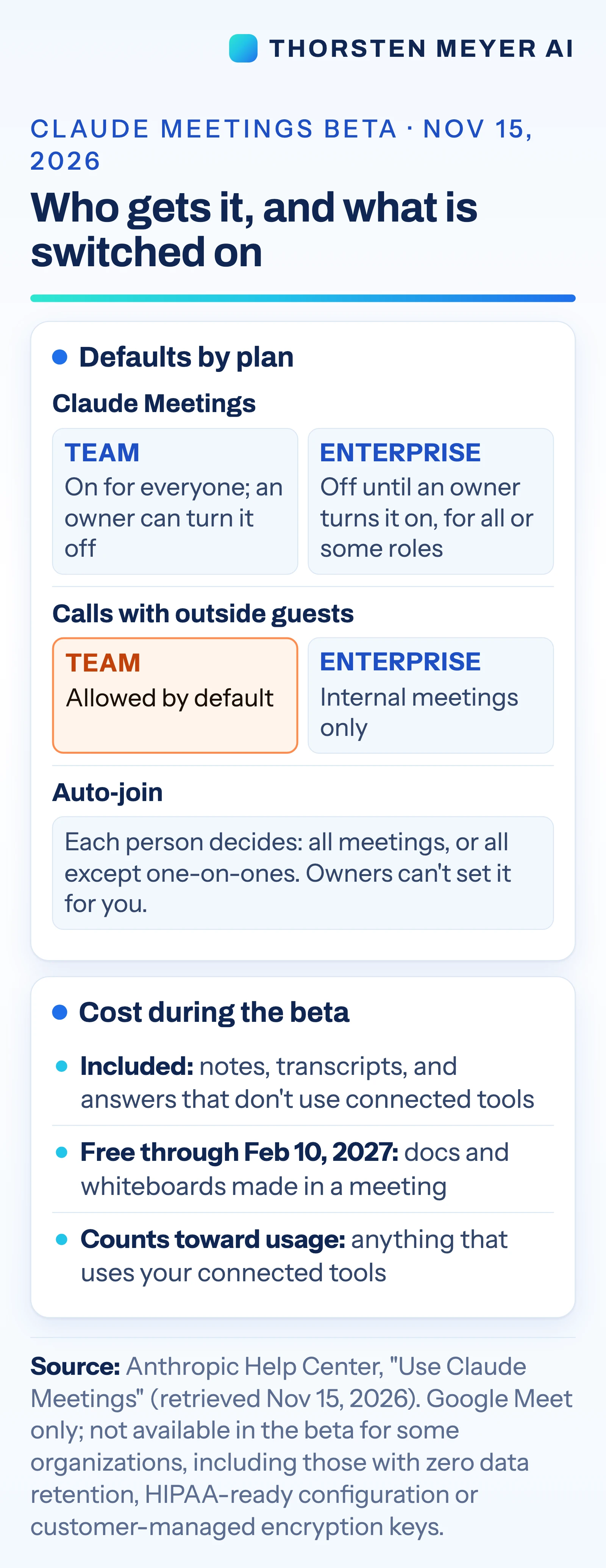
AI Notes Become Live Work Products
The beta combines meeting transcription with document creation and access to connected tools. Instead of leaving participants with notes to turn into a plan later, Claude can draft a document during the call and post answers in the shared chat. Anthropic’s example describes a team planning a customer event: a participant asks Claude to start a plan, then asks it to look up a prior event’s cost. Anthropic says Claude requests approval before using a connected tool for the lookup.
That workflow could reduce follow-up work for teams already using Claude, but it also places an AI system in a conversation where people may discuss internal plans or invite external guests. The service visibly joins and posts a notice, yet Anthropic’s guidance assigns responsibility for consent to the person adding it: users should make sure everyone on the call is comfortable being transcribed. That makes meeting policy, guest settings and participants’ expectations central to adoption, alongside the feature’s usefulness.
Products Worth Considering

LG UltraGear 32GX870A-B 32-inch 4K UHD OLED Gaming Monitor

Bose QuietComfort Headphones – Wireless Bluetooth Over-Ear Noise Cancelling Headphones, Petal Pink Limited Edition

Logitech MX Keys S Combo Wireless Keyboard and Mouse, Graphite
As an affiliate, we earn on qualifying purchases.
Google Meet Is the First Platform
Anthropic’s November 12 announcement describes Google Meet as the only supported platform at launch and says support for other platforms is coming soon, without giving a date. Use requires a Claude Team or Enterprise plan and is available in Claude and Claude Desktop. The announcement therefore describes a beta tied to existing business subscriptions, rather than a standalone meeting product.
Users can set personal auto-join for all meetings or all except one-on-ones. Anthropic says organization owners cannot set auto-join on behalf of individual users. For meetings where outside guests are not allowed, Claude leaves if a guest joins. If guest participation is allowed, Claude can continue taking notes, but it does not reply in chat. After the call, colleagues on the invitation receive a recap email; guests do not. Anthropic says meeting materials are available on the meeting page, which also includes an organization-only chat.
AI note-taking in video calls already exists, and market context cited in the source material points to an established category. A Gartner report quoted by Computerworld described Claude Meetings as “a beta entrant in a mature market.” Anthropic’s stated distinction is the combination of live answers, connected tools and artifacts created during the call. The beta’s longer-term position will depend in part on platform expansion, administrative controls and the eventual terms for creating those artifacts.
““It takes the notes, answers questions, and builds artifacts, such as docs, whiteboards, and slides, live during the call.””
— Anthropic Help Center, “Use Claude Meetings”
Retention and Future Pricing Remain Open
Anthropic’s announcement and Help Center information, as retrieved November 15, do not specify how long meeting records are retained. They also do not state the price for documents and whiteboards after February 10, 2027, or give a launch date for platforms beyond Google Meet. Those details may affect organizations deciding whether to enable the beta for routine meetings.
The source material does not settle every practical question about consent or oversight, including how organizations should handle participants who object after a meeting has begun. It says Claude posts a notice and tells users to check that everyone is comfortable with transcription, but does not describe a separate participant consent control. Anthropic also says some configurations cannot use the beta, without listing every affected organization or explaining whether those restrictions may change.
Watch for Platform and Pricing Details
Anthropic says support for other meeting platforms is coming, but has not announced dates. Organizations considering the beta can check whether their plan and security configuration qualify, review the Team or Enterprise defaults with an owner, and decide how meeting hosts should communicate Claude’s presence to participants.
The next clear pricing milestone is February 10, 2027, when the stated free period for documents and whiteboards ends. Anthropic has not published the terms that will apply after that date. Retention information and any further controls or platform announcements will also help customers judge how the feature fits their meeting policies.
Key Questions
Who can use Claude Meetings?
Anthropic says the beta is for Claude Team and Enterprise customers in Claude and Claude Desktop. Some organizations, including those with zero data retention, HIPAA-ready configuration or customer-managed encryption keys, are excluded during the beta.
Does Claude record meeting audio?
Anthropic says it saves a transcript, summary and screen descriptions, not audio. It appears as a participant and posts a notice in the meeting chat.
Can Claude join meetings with outside guests?
That depends on the setting. Team allows outside guests by default; Enterprise is limited to internal meetings by default. If guests are disallowed, Claude leaves when one joins. If they are allowed, Claude can take notes but does not reply in chat.
Will meeting documents cost extra?
Notes, transcripts and answers are included in Team and Enterprise plans. Anthropic says documents and whiteboards created in meetings are free through February 10, 2027; pricing after that date has not been stated. Connected-tool use counts toward usage.
Source: Thorsten Meyer AI