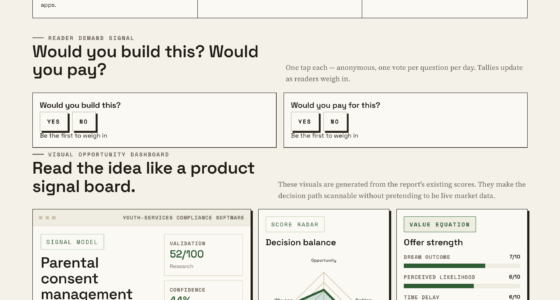
📊 Full opportunity report: A Clearer Way To Spot Scope Changes Before They Add Up on IdeaNavigator AI — validation score, market gap, and execution plan.

Get business pricing on monitors, keyboards and dev gear
- Business-only prices and quantity discounts
- Tax-exempt purchasing
- Multiple users, one account, clear invoices
TL;DR

IdeaNavigator AI has outlined a proposed tool for fixed-price consultants that would compare incoming client requests with contracted work, estimate accumulated out-of-scope effort and draft boundary-setting replies. The concept is not a reported product launch: its suggested test is a three-month pilot with 30 consultants, measuring signed add-ons and changes in effective hourly rates.
IdeaNavigator AI has proposed a scope-change detector for consultants who sell fixed-price packages, a tool intended to flag client requests that fall outside an agreed contract before small additions accumulate. In its published concept, IdeaNavigator AI describes a workflow that would connect email and project tools, track estimated out-of-scope effort and draft replies offering paid add-ons. The proposal remains a product concept and validation plan, not a reported launch or proven service.
IdeaNavigator AI frames the problem as a familiar pattern in fixed-fee engagements: clients make seemingly minor requests, such as another revision or a short call, that may not be covered by the original agreement. As described in the proposal, each request can appear manageable on its own, while the added labor gradually reduces a consultant’s effective hourly earnings. The proposal argues that addressing the issue late can make a boundary-setting conversation more difficult, after extra work has already accumulated.
The proposed minimum viable product would connect to a consultant’s email and project-management tools and compare incoming requests with the contracted scope. IdeaNavigator AI says the tool would estimate accumulated out-of-scope effort in real time and prepare a tactful response that could offer a paid addendum instead of simply accepting the extra work. The proposal does not describe a technical implementation, integrations, pricing or a working prototype.
IdeaNavigator AI suggests a monthly subscription per consultant as the business model. To test whether the concept is useful, its proposal recommends a three-month trial involving 30 consultants, measuring revenue recovered through signed addenda and changes in effective hourly rates compared with baseline engagements. The source does not report that a pilot has begun or provide outcome figures.
Product concept · Fixed-price consulting
A Clearer Way to Spot Scope Changes Before They Add Up
IdeaNavigator AI proposes a tool that compares client requests with contracted work, estimates accumulated out-of-scope effort, and drafts replies that offer paid add-ons. It is a concept with a proposed validation plan—not a reported launch or proven service.
No product launch reported
Proposed, not confirmed underway
Delivering fixed-price packages
Signed add-ons and effective rates
Small requests can quietly change the economics
An extra revision or a short call may seem manageable on its own. Repeated requests beyond the agreement can add labor without adding fees, reducing the consultant’s effective hourly earnings. Raising the issue after work has accumulated may make the boundary-setting conversation harder.
A small addition arrives
A client asks for another revision, a quick call, or a deliverable beyond the agreed package.
Extra effort adds up
Each request can look minor while the total unpaid work gradually reduces the value of the fixed fee.
The conversation comes late
Without a clear moment to flag the change, negotiating a paid add-on can feel more difficult after the work is done.
From incoming request to a considered response
The proposed minimum viable product would connect to email and project-management tools, compare incoming requests with contracted scope, and surface an effort estimate with a possible paid-addendum reply.
Connect
Link email and project tools to the engagement context.
Compare
Check a new request against the contracted work.
Estimate
Make accumulated out-of-scope effort visible in real time.
Draft
Prepare a tactful reply that can offer a paid addendum.
Useful alerts need to be accurate and relationship-aware
Would the tool help consultants choose what to accept, decline, or price?
A false flag could make a routine clarification feel like a billing dispute. A missed request could leave extra work unpaid. The proposal has not yet shown that automated comparisons can handle real contracts, exceptions, and client communications reliably.
Flag rate
How often does the detector identify requests as outside scope?
Agreement
How often do consultants agree with the detector’s flags?
Client response
How many suggested paid add-ons do clients sign?
Time and trust
How much review time is required, and how do client conversations change?
What the proposal says—and what remains open
A narrow first use case
- For consultants selling fixed-price, productized services.
- Compare client requests with the agreed contracted scope.
- Estimate out-of-scope effort and draft a paid-addendum reply.
- Test over three months with 30 consultants.
- Measure signed add-ons and effective hourly-rate changes.
Product, demand, and safeguards
- No launch, working prototype, pilot start, or outcome figures reported.
- No integrations, pricing, technical implementation, team, or schedule specified.
- No market-size, adoption, or consultant-demand evidence provided.
- Recruitment, baseline selection, and additional-work time measurement are undefined.
- Data storage, access, privacy safeguards, and review controls are not described.
Revenue is only part of the story
Signed addenda and effective-rate changes would show whether the concept may help recover revenue. They would not, by themselves, show whether flags are accurate, clients respond well, or users spend too much time reviewing alerts.
Does the contract comparison hold up?
Real agreements contain exceptions and ambiguous language. The detector has not been reported as tested against real contracts or messages.
Do replies help preserve trust?
A tactful draft could help set boundaries, but client reactions and relationship outcomes remain unknown.
Can the tool handle sensitive context?
Privacy, data access, storage, and consultant approval of drafted replies are important details the proposal does not establish.
How Early Scope Alerts Could Help
IdeaNavigator AI’s concept is based on the premise that a tool could help consultants identify when a new request falls outside a contract, giving them a clearer moment to accept, decline or price the extra work. The proposed real-time effort estimate is intended to make the financial effect visible while an engagement is underway, rather than only after repeated favors have reduced the value of the fixed fee. Whether the tool can do this reliably remains untested.
For consultants, the practical test is not simply whether software can identify additional requests. It is whether its comparisons are accurate enough to be useful and whether suggested replies help preserve client relationships while setting boundaries. A false flag could make an ordinary clarification feel like a billing dispute; a missed request could leave the consultant doing unpaid work. The pilot measures proposed by IdeaNavigator AI—signed addenda and effective-rate changes—would address revenue, but would not by themselves show how clients respond or how much time users spend reviewing alerts.
The idea also reflects a tension in fixed-price services: packaging work can make pricing and deliverables easier to communicate, but it does not eliminate ambiguity about what counts as included work. IdeaNavigator AI proposes a monitoring tool as one way to manage that ambiguity. Its concept does not establish that consultants will pay for it or that automated scope comparisons can handle the language and exceptions in real contracts.
Products Worth Considering

LG 34GX90SA-W 34-inch Ultragear WQHD OLED Curved Gaming Monitor

Samsung 27-Inch Odyssey QD-OLED G8 4K 240Hz Gaming Monitor

Samsung 27 Odyssey OLED G5 (G50SF) QHD QD-OLED Gaming Monitor
As an affiliate, we earn on qualifying purchases.
Fixed Fees, Small Requests, and Scope
IdeaNavigator AI frames the opportunity around consultants who sell fixed-price, productized services. Unlike hourly billing, a fixed fee does not automatically add payment when a client asks for more time or another deliverable. If the contract is clear and both sides follow it, the model can keep costs predictable; when requests fall outside its boundaries, the consultant may need to negotiate a change or absorb the work.
In its proposal, IdeaNavigator AI argues that fixed-price offerings have expanded as consultants moved away from hourly billing, and that email and task-management integrations could make request-to-contract comparisons automatable. This is the rationale for the concept, not evidence that the market has adopted this kind of software. The proposal provides no market-size estimates, adoption data or evidence of demand from consultants.
The idea is deliberately framed as a narrow first test for one buyer: the consultant delivering fixed-price packages. IdeaNavigator AI does not describe a tool for clients, agencies or other contract-based work. Keeping the first use case focused could make it easier to test whether request tracking and paid-addendum suggestions address a measurable problem before expanding the product.
Product Demand and Accuracy Remain Untested
IdeaNavigator AI’s published concept does not say whether a product is being built, when a pilot might begin, or which email and project platforms it would support. It names no team and provides no launch schedule, subscription price, technical details or consultant feedback. The source also does not report testing the detector against real contracts or client communications.
The proposed validation plan leaves several questions open. It does not specify how the 30 consultants would be recruited, how baseline engagements would be selected, or how the trial would account for differences in contract terms, project length and client behavior. Nor does it define how the tool would measure the time spent on additional work. Until a test produces results, claims about recovered revenue, improved rates and smoother client conversations remain unverified.
Accuracy and privacy would also matter in practice because the concept depends on reading contract and project communications. The proposal does not explain how data would be stored, who could access it, how estimates would be reviewed, or whether a consultant must approve every drafted response. Those operational details are not established by the concept.
A Three-Month Pilot Is Proposed
IdeaNavigator AI’s proposed next step is a three-month test with 30 consultants, comparing signed paid addenda and changes in effective hourly rates against baseline engagements. The source does not confirm that the test is scheduled or underway, so its start date and any later findings are unknown.
If a pilot proceeds, useful reporting would show how often the detector flags requests, how often consultants agree with those flags, how many suggested add-ons clients sign, and whether the tool changes the time or revenue associated with engagements. Information about participant selection, privacy safeguards, pricing and platform support would also help readers judge whether the concept is practical beyond a small test. For now, IdeaNavigator AI has described a proposed workflow and validation plan, not a commercially available or proven product.
Source: IdeaNavigator AI
Key Questions
Has the scope-change detector launched?
No launch is reported. The development described is a product concept and a proposed plan to test it with consultants.
Who is the proposed tool for?
It is aimed at consultants delivering fixed-price packages, rather than consultants working solely on hourly billing or a broader set of buyers.
How would the detector work?
The proposed tool would connect email and project tools, compare incoming client requests with the contracted scope, estimate accumulated out-of-scope effort and draft a response that could offer a paid add-on.
How would the concept be evaluated?
The suggested test is a three-month pilot with 30 consultants, measuring revenue from signed addenda and changes in effective hourly rates against baseline engagements. No results are available.
What is still unknown?
The launch status, schedule, integrations, subscription price, data safeguards and accuracy of the scope comparisons have not been specified. It is also unknown whether consultants or their clients would adopt the workflow.
Source: IdeaNavigator AI