
Astrology and astronomy may seem similar, but they differ markedly. Astrology explores how celestial positions influence personality and life paths, appealing more to belief than science. In contrast, astronomy studies the universe using empirical data and mathematical models. It examines celestial bodies’ physical properties without attributing any mystical influences. Understanding these distinctions helps you navigate between spiritual insights and scientific facts. Discovering more about these fields can deepen your appreciation for the cosmos.
Key Takeaways
- Astrology interprets celestial positions to provide personal insights, while astronomy studies the universe through empirical data and scientific methods.
- Zodiac signs in astrology are linked to personality traits, whereas astronomy focuses on the physical properties of celestial bodies.
- Astrology relies on subjective analysis and interpretative frameworks, unlike astronomy, which uses mathematical models and empirical evidence for validation.
- Understanding the distinction between astrology and astronomy fosters critical thinking and differentiates belief systems from scientific inquiry.
- Appreciating both fields enriches our understanding of the cosmos, balancing personal meaning with factual knowledge of the universe.

While you might find both astrology and astronomy fascinating, they serve very different purposes. Astrology focuses on the influence of celestial bodies on human behavior and personality, while astronomy is the scientific study of the universe beyond Earth’s atmosphere. Understanding this distinction can help you appreciate how these fields complement each other, yet diverge considerably in their intentions and methodologies.
When you think about astrology, you’re often drawn to the idea of zodiac signs. Each sign corresponds to specific dates, and people born under a particular sign are believed to exhibit certain traits and tendencies. Astrology claims that planetary alignments at the time of your birth influence your personality and life path. For instance, if you’re a Leo, you might be perceived as confident and charismatic, traits attributed to your sun sign. These zodiac signs serve as a framework through which many interpret their lives, relationships, and even career choices.
On the other hand, astronomy deals with the actual positions, movements, and characteristics of celestial bodies in the universe. Astronomers observe stars, planets, and galaxies, using mathematical models and empirical evidence to understand how they function. They study phenomena like planetary alignments, which occur when planets align in a specific configuration. However, while these alignments may have astrological significance for some, astronomers focus on their physical implications, such as gravitational effects and orbital mechanics.
So why does this distinction matter? Recognizing the difference between astrology and astronomy allows you to discern between belief and scientific fact. While astrology can offer personal insights and a sense of connection to the cosmos, it lacks the empirical foundation that astronomy provides. You might find joy in reading your horoscope or discussing zodiac signs with friends, but it’s essential to remember that these interpretations are subjective. Additionally, engaging with educational toys can enhance cognitive skills, much like how learning about astronomy enriches our understanding of the universe.
In a world where science and spirituality often intersect, understanding the line between astrology and astronomy can enrich your perspective. You can enjoy the insights astrology offers while also appreciating the rigorous inquiry of astronomy. By embracing both fields, you can cultivate a broader understanding of the universe and your place within it, without losing sight of the distinctions that define them. So, the next time you look up at the stars, remember the balance between wonder and knowledge.
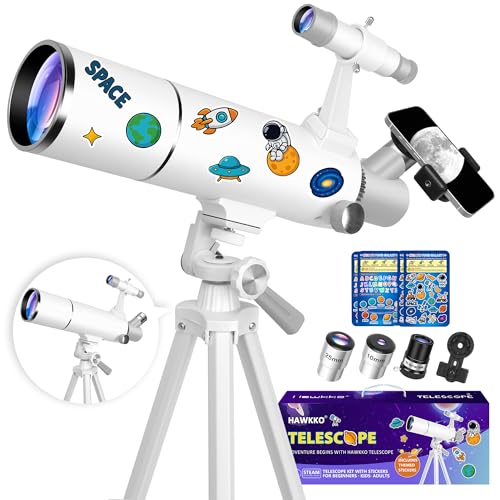
Hawkko 80mm Aperture 500mm Telescope for Kids 8-12 & Adults Beginners
- Family-Friendly Space Exploration: Ideal for kids and adults to explore space together
- Bright, Clear Images: 80mm multi-coated lens for vivid views
- Versatile Magnification: Adjusts from 20X to 150X zoom
As an affiliate, we earn on qualifying purchases.
As an affiliate, we earn on qualifying purchases.
Frequently Asked Questions
Can Astrology Predict Specific Life Events Accurately?
You might think astrology’s got a crystal ball that reveals every twist and turn of your life, but it doesn’t. While zodiac predictions can provide insights, they’re more like vague road signs than precise GPS coordinates. Horoscope accuracy varies widely, and many people find them entertaining rather than exact. So, if you’re looking for a detailed life map, astrology’s not your best bet; it’s more about guidance than pinpointing specific events.
Is Astronomy Purely a Scientific Field?
Yes, astronomy’s purely a scientific field. It focuses on celestial mechanics and the study of planets, stars, and galaxies, using data and observations to understand the universe. You’ll explore how planetary influences affect cosmic phenomena rather than personal life events. While it’s deeply rooted in mathematics and physics, it doesn’t engage in interpretations like astrology does. So, when you think of astronomy, think of rigorous scientific inquiry and exploration.
How Do Cultures View Astrology Differently?
Cultures view astrology like a colorful tapestry, each thread representing different belief systems. Some embrace it as a guiding force, while others dismiss it as mere superstition. You might find that in Western cultures, people often see astrology as entertainment, while in Eastern traditions, it plays a significant role in decision-making. This cultural interpretation creates a rich landscape where the same stars ignite vastly different beliefs, making astrology a fascinating yet divisive subject.
Are There Any Scientific Studies Supporting Astrology?
No, there aren’t credible scientific studies supporting astrology. Most scientists approach astrology with skepticism, as it lacks empirical evidence. While some individuals may claim personal experiences that align with astrological predictions, these anecdotes don’t hold up under rigorous scientific scrutiny. The absence of reliable data means astrology isn’t considered a science. If you’re curious about astrology’s claims, it’s essential to balance that interest with an understanding of its scientific limitations.
Can Astrology and Astronomy Coexist Peacefully?
Sure, astrology and astronomy can coexist peacefully, despite the irony that one’s a science and the other’s often dismissed as pseudoscience. Historically, people viewed them as intertwined, with early astronomers dabbling in astrological predictions. You can appreciate the beauty of star patterns while recognizing astrology’s lack of scientific support. Embracing both perspectives lets you enjoy the rich tapestry of human belief without getting swept up in modern debates over their validity.

DEQIYIJI Witchy Zodiac Sign Gothic Moon Necklace for Women Trendy Jewelry, Astrology Whimsigoth Statement Pendant, Vintage Boho Accessories, Alt Whimsical Birthday Gifts Cancer
- Unique Double-Sided Pendant: Spinning glass cabochon in moon frame
- Gothic Witchy Style: Complements bohemian and celestial outfits
- Hypoallergenic & Tarnish-Resistant: Stainless steel chain, nickel and lead free
As an affiliate, we earn on qualifying purchases.
As an affiliate, we earn on qualifying purchases.
Conclusion
In the cosmic dance of stars, it’s easy to see why astrology and astronomy might blend together in your mind. While astrology seeks to interpret your life’s path through celestial influence, astronomy grounds you in the scientific study of those very same stars. Understanding this distinction not only enriches your perspective but also deepens your appreciation for the universe. So the next time you look up at the night sky, consider both the science and the stories behind those twinkling lights.

Science Can Solar System for Kids, Talking Astronomy Solar System Model Kit
- Immersive Solar System Projection: Projects planets onto any surface
- Bilingual Talking Planets: Provides educational facts in English and Spanish
- 24 HD Space Exploration Slides: Includes 24 full-color space images
As an affiliate, we earn on qualifying purchases.
As an affiliate, we earn on qualifying purchases.

Celestial Navigation: A Complete Home Study Course, Second Edition
As an affiliate, we earn on qualifying purchases.
As an affiliate, we earn on qualifying purchases.