Brain-computer interfaces are making significant progress toward enabling thought-to-text messaging, but it’s still mostly experimental. Researchers have improved decoding of neural signals, bringing seamless communication closer, but challenges like accuracy, consistency, and ethics remain. Technical hurdles like long-term safety and privacy concerns also slow practical adoption. If you want to understand how close we truly are and what obstacles still exist, there’s more to uncover as you explore further.

Get business pricing on monitors, keyboards and dev gear
- Business-only prices and quantity discounts
- Tax-exempt purchasing
- Multiple users, one account, clear invoices
Key Takeaways
- Neural decoding advances allow for interpreting some neural signals, but translating complex thoughts into text remains experimental.
- Current BCI technology can detect basic speech or motor intentions but struggles with continuous, detailed thought-to-text conversion.
- Most developments are limited to clinical or laboratory settings, with practical, everyday thought-to-text communication still years away.
- Ethical and safety concerns, including data privacy and consent, impede widespread deployment of thought-to-text BCIs.
- Ongoing research and technological improvements are progressing, but reliable, seamless thought-to-text messaging is not yet commercially available.
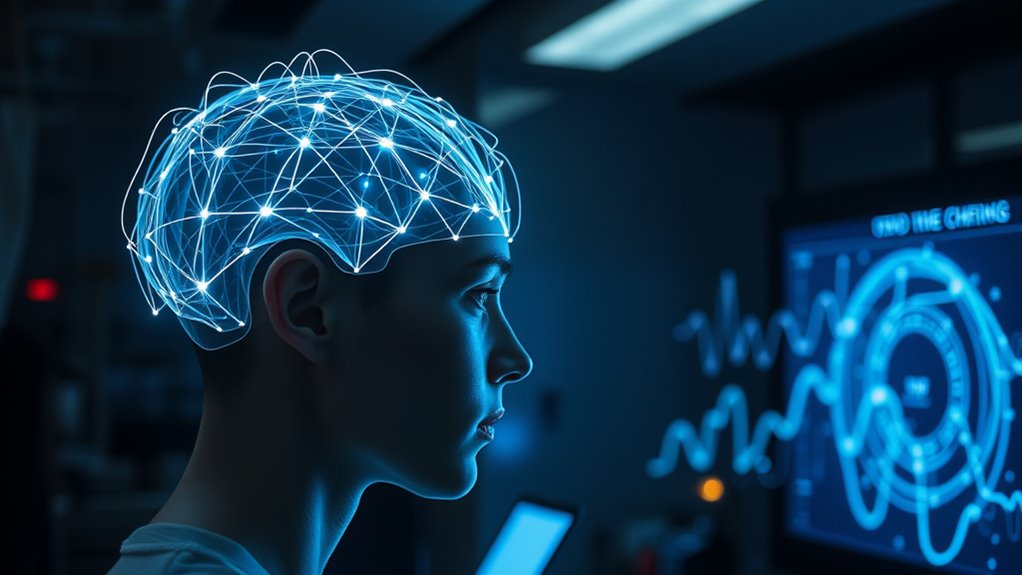
Brain-Computer Interfaces (BCIs) are systems that enable direct communication between your brain and external devices. Imagine being able to translate your thoughts into text or commands without speaking or typing. That’s the promise behind recent advances in neural decoding, which involves interpreting electrical signals from your brain to understand your intentions. Researchers have made significant strides in decoding neural activity, especially in controlled environments, making the idea of thought-to-text messaging seem more attainable. With specialized algorithms and machine learning techniques, BCIs can now pick up subtle patterns in neural signals associated with speech or motor intentions, bringing us closer to seamless communication. Additionally, the development of high-quality home theatre projectors can enhance the immersive experience of visual displays, though this is a separate technological area. However, despite these technological leaps, there’s still a long way to go before this becomes a practical, everyday reality. Challenges in accurately decoding complex thoughts, maintaining consistent performance, and ensuring safety remain hurdles to overcome.
As you consider this technology, it’s important to reflect on the ethical implications involved. Neural decoding raises profound questions about privacy—if your thoughts can be read or interpreted, who owns that data? Could it be misused or accessed without your consent? The potential for neural data to reveal sensitive information extends beyond simple thoughts, possibly exposing emotions or intentions you’d prefer to keep private. There’s also concern about consent, especially as BCIs become more sophisticated and capable of extracting ever more detailed neural information. Ensuring that users maintain control over their own brain data is essential, yet complex. Furthermore, the development of thought-to-text systems could lead to new forms of communication, but also new avenues for manipulation or coercion.
While many companies and research institutions are working hard to improve neural decoding accuracy, the ethical implications demand equal attention. Researchers and policymakers need to establish standards and safeguards that protect individual rights, prevent misuse, and promote transparency. You should be aware that, with current progress, thought-to-text messaging remains experimental and limited mostly to clinical or laboratory settings. Still, as the technology advances, it’s imperative to address these ethical issues proactively. Ultimately, neural decoding is a powerful tool with transformative potential, but it must be developed responsibly, respecting your privacy and autonomy. Only then can we truly harness BCIs’ promise of effortless, thought-based communication without compromising your fundamental rights.
Top picks for "brain computer interfac"
As an affiliate, we earn on qualifying purchases.
Frequently Asked Questions
What Industries Outside Healthcare Are Exploring Brain-Computer Interfaces?
You might not realize it, but industries like gaming and education are exploring brain-computer interfaces beyond healthcare. Neurogaming innovation aims to create immersive experiences, while cognitive enhancement helps boost focus and learning. These technologies enable users to control games or learn new skills using only their thoughts. As BCI tech advances, expect more personalized, intuitive tools that could revolutionize entertainment, training, and productivity outside the medical field.
How Do BCIS Compare to Traditional Assistive Communication Devices?
Imagine trying to tune a radio with static; that’s how traditional assistive devices often feel. BCIs offer more precise communication by improving neural accuracy and signal stability, making your thoughts clearer and faster to transmit. Unlike conventional methods, BCIs directly interpret brain signals, reducing frustration. You could experience smoother, more natural interactions, transforming how you communicate and regain independence, much like switching from static to crisp, clear radio reception.
What Are the Ethical Concerns Surrounding Mind-Reading Technologies?
You should consider the ethical concerns surrounding mind-reading technologies, especially privacy concerns and consent challenges. These devices can access your thoughts without full understanding or control, risking misuse or unauthorized data collection. Ensuring informed consent is tricky because thoughts are deeply personal. As these technologies develop, it’s vital to establish strict regulations to protect individual privacy and prevent potential abuses, maintaining trust and ethical integrity.
How Affordable Will BCI Technology Become for Everyday Users?
Imagine a world where BCI tech is as common as smartphones. As cost reduction accelerates and accessibility improves, this future feels closer. Currently, prices are high, but with mass production and technological advances, affordability will rise. You could soon use BCI devices without breaking the bank, making thought-to-text messaging a reality for everyday users—transforming communication much like the smartphone did a generation ago.
What Are the Main Technical Hurdles to Achieving Real-Time Thought-To-Text Translation?
You face key hurdles like signal latency, which delays real-time translation, and decoding accuracy, vital for clear communication. Improving these involves developing faster algorithms and more precise sensors. You need to address variability in brain signals and reduce noise to enhance decoding. Overcoming these technical challenges will bring thought-to-text messaging closer to everyday use, making communication seamless and faster.
Conclusion
You might think thought-to-text messaging is just around the corner, but it’s actually closer than you imagine. With rapid advancements in brain-computer interfaces, you could be texting your thoughts in the blink of an eye—literally! Soon, you’ll send messages faster than you can blink, revolutionizing communication forever. The future isn’t just near; it’s practically knocking at your door, ready to turn your brainwaves into instant messages. Get ready—mind-to-text is about to change everything!
Fall Picks
fall essentials
As an affiliate, we earn on qualifying purchases.