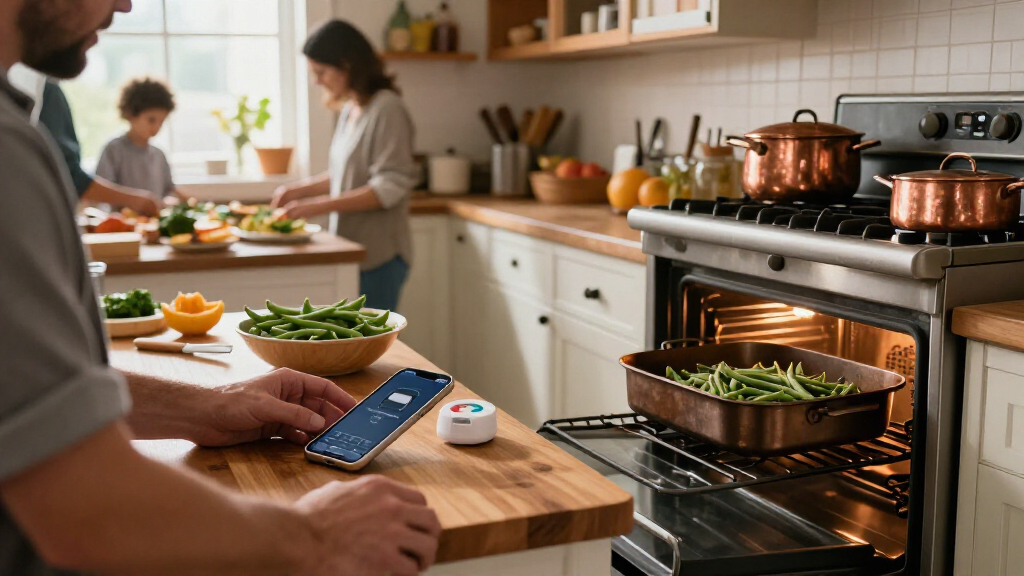

🔍 Read the full analysis: AI-Powered Kitchen Timers For A Smoother Thanksgiving Meal on ThorstenMeyerAI.com

Get business pricing on monitors, keyboards and dev gear
- Business-only prices and quantity discounts
- Tax-exempt purchasing
- Multiple users, one account, clear invoices
TL;DR
AI-powered kitchen timers can interpret spoken requests, manage multiple labeled countdowns and, in some products, suggest alerts from recipes. Their performance and features vary, and they cannot verify that food is safely cooked. For Thanksgiving, check alerts and timer settings, and keep a basic backup timer available.
AI-powered kitchen timers can interpret spoken cooking requests, keep multiple labeled countdowns and sometimes suggest alerts from recipe steps, according to ThorstenMeyerAI.com’s Thanksgiving guide. The features may help cooks coordinate a crowded Thanksgiving meal, but they vary by product, can mishear commands and cannot determine whether food is safely cooked.
The guide describes systems that let a cook say, for example, “Set pasta for nine minutes and remind me to check the sauce in five.” A capable timer should create two separate alerts and associate each with the right task. Labels matter: when several timers ring close together, “pasta” and “sauce” are more useful than indistinguishable beeps.
Some products also connect timer suggestions to recipes. They may identify a stated cooking duration and offer an alert, but the guide recommends reviewing those suggestions before starting them. The features described under “AI-powered” are not standardized; a connected device may rely on fixed voice commands or ordinary automation rather than flexible interpretation. Buyers should check the maker’s current feature list, including whether functions require an internet connection, a subscription or another compatible device.
Voice control can be less dependable around a running tap, ventilation fan or conversation. An ambiguous phrase or missed number can produce the wrong duration. The guide recommends checking the screen or spoken confirmation, learning how to pause or change one timer without resetting others, and keeping a basic phone or manual timer as a backup. These are practical precautions, not evidence that every device has the same error rate.
Check what a product actually does: voice control and Wi-Fi alone do not prove it uses AI.
Use clear timer names, review spoken commands, and confirm recipe-generated alerts before cooking.
Compare alert options, timer adjustments, offline use, privacy controls, and total cost.
Treat recipe timers as reminders to check; use a food thermometer when safe temperature matters.
Keeping Thanksgiving Tasks on Track
Thanksgiving often involves several dishes with different cooking and resting schedules. A hands-free request can save a cook from touching a phone with flour or food on their hands, while separate, named alerts can make it easier to decide which task needs attention. That is the clearest potential benefit described in the guide: less juggling, not automated cooking.
The distinction matters because a timer only tracks an interval or reminder. It does not inspect a turkey, measure its internal temperature or know whether an oven is heating correctly. Treating a countdown as proof that food is ready could create a safety risk. Cooks still need to follow reliable food-safety guidance and check food with an appropriate method. A timer can prompt that check; it cannot replace it.
For a holiday meal, reliability and ease of correction may matter more than conversational features. A timer that displays clear labels, lets users adjust one task at a time and still offers a straightforward manual control may be more useful than a system that accepts elaborate requests but makes mistakes hard to spot.
Products Worth Considering

DJI Osmo 360 Motorcycle Handlebar POV Combo

Apple MacBook Air 15-inch Laptop with M5 Chip, 16GB Memory, 512GB SSD, Liquid Retina Display, and Touch ID (Midnight)

Logitech MX Keys S Combo Wireless Keyboard and Mouse, Graphite
As an affiliate, we earn on qualifying purchases.
What the AI Label Covers
The source guide distinguishes among voice-controlled timers, connected devices and recipe services. These categories can overlap, but Wi-Fi connectivity by itself does not establish that a product uses AI. Some systems follow preset commands; others may interpret more flexible speech or produce recipe-based suggestions. A product description should explain which actions it supports, such as naming timers, changing them by voice or reviewing recipe alerts.
The guide says that, based on information available through mid-2024, conversational and generative AI features were being added to existing assistants, recipe services and smart displays. That observation is not a current product-by-product survey, and it does not establish which Thanksgiving products now offer particular features. Software versions, regions, paid tiers and cloud services can affect availability, so shoppers should verify current documentation rather than assume a feature remains available.
Limits and Product Details to Check
The supplied material is a consumer guide, not a report of a newly launched device or a comparative test of kitchen timers. It gives no independent accuracy measurements, product-by-product results or evidence that AI timers reduce cooking errors. The scale of any benefit, and how often systems mishear requests, remain unclear from this material.
Specific Thanksgiving models, prices, subscription terms, privacy practices and offline functions are not identified. The guide advises checking whether a timer can work without internet access, what data its voice features collect, how alerts are delivered and what happens if a cloud service is unavailable. Those answers may differ by product and software version. No particular device is shown to verify doneness or food safety.
Check Features Before the Meal
Before relying on a timer for Thanksgiving, consult the manufacturer’s current documentation for supported commands, recipe functions, subscription requirements, privacy settings and offline behavior. Test the device in the kitchen’s usual noise conditions. Set a few labeled timers, confirm each duration and practice changing or dismissing one without disturbing the others.
During cooking, review recipe-derived suggestions before activating them, check spoken requests on the display where possible and keep a separate timer ready. The source material does not identify a forthcoming product launch or industry milestone. For readers, the next practical step is to test the exact timer they plan to use and rely on appropriate food-safety checks—not a countdown—to judge whether a dish is done.
Key Questions
What does an AI-powered kitchen timer do?
Depending on the product, it can interpret spoken requests, create or label multiple timers, and suggest alerts based on recipe steps. Features vary, so check the manufacturer’s current description.
Can a kitchen timer tell me whether turkey is safely cooked?
No. A timer tracks time or reminds you to check; it does not confirm a dish’s internal temperature or safety. Use an appropriate food-safety check.
Will an AI timer work if the internet goes out?
That depends on the device and which features it uses. Check its offline behavior in current product documentation and keep a basic backup timer available.
What should I test before Thanksgiving?
Try labeled timers in a noisy kitchen, confirm durations, and practice pausing, adjusting and dismissing one timer without resetting the others. Review any recipe-based suggestions before starting them.
Source: ThorstenMeyerAI.com