

📊 Full opportunity report: The Hidden Difficulties Of Regulating Artificial Minds on ThorstenMeyerAI.com — validation score, market gap, and execution plan.
TL;DR
Europe has established comprehensive AI regulations but lags in building its own frontier AI technology. This gap poses risks in defending against hybrid threats such as drone attacks and cyber sabotage.
Overnight Tuesday, a drone carrying explosives was spotted near Leipzig/Halle airport’s south runway, prompting police to defuse and destroy it. The incident has intensified concerns about hybrid threats targeting critical infrastructure in Europe, especially at a key logistics hub linked to military and Ukraine support. Meanwhile, broader debates about Europe’s ability to defend itself against such threats have gained prominence, focusing on the gap between regulation and technological capability.
The drone was discovered in the cargo zone of Leipzig/Halle, a major European freight hub and military logistics center. German authorities confirmed the device was armed with explosives, and a bomb-disposal robot was deployed to neutralize it. Simultaneously, a DHL cargo aircraft diverted after striking an unknown object mid-air, raising suspicion of coordinated sabotage. Germany has launched a counterterrorism investigation, with Interior Minister Alexander Dobrindt describing the threat as a ‘professional hybrid scenario’ and ‘a new level of danger.’
Experts highlight that hybrid warfare involves multi-domain operations—cyber attacks, sabotage, disinformation—designed to operate under the threshold of open conflict. The tools enabling such campaigns increasingly rely on advanced artificial intelligence systems. Europe’s current AI landscape, heavily regulated but lagging in frontier development, is seen as a strategic vulnerability, especially in defense applications where AI’s role in threat detection and response is critical.
An explosive drone on a military cargo hub’s runway. A “professional hybrid threat,” said the interior minister — “a new level of danger.” It’s a moment to say something uncomfortable about how Europe is meeting the era it has entered.
▲ Opinion · strategic argument is the author’s ownEurope’s reflex to a new technology is to regulate it — and it’s genuinely good at it. The AI Act is the most comprehensive AI law on Earth. The discomfort is what sits underneath.
The sloppy version of this argument is wrong, and I won’t make it. The real connection runs one level deeper — through the word “hybrid.”
The rebuttal: just use American AI. For many things, today, Europe can. But defense is the specific case where you can’t.
The strongest version of the other side, because parts of it are right and it deserves to be heard.
- Regulation and capability aren’t zero-sum — Europe is investing (InvestAI, gigawatt data centers)
- Drone defense is mostly physical security and intelligence, not frontier LLMs — I overweight my own field
- Sovereign defense AI may need a smaller controllable model, not a leaderboard chase
- Setting global norms has real value, capability or not
Only capability does that — and it’s the thing we’ve been legislating around instead of building.
Implications of Europe's AI Capability Gap in Hybrid Warfare
This incident underscores a critical vulnerability: Europe’s strong regulatory stance on AI has not translated into technological dominance. While the EU has developed the world’s most comprehensive AI law, its AI models lag behind U.S. and Chinese counterparts in frontier capabilities. This gap could hinder Europe’s ability to develop autonomous defense systems necessary to counter sophisticated hybrid threats, such as drones and cyber-attacks, in real-time.
Furthermore, reliance on foreign AI providers for defense tools risks dependency and strategic disadvantage. As hybrid threats evolve rapidly, Europe’s capacity to build and control its own AI-driven defense infrastructure becomes vital for national security and sovereignty.
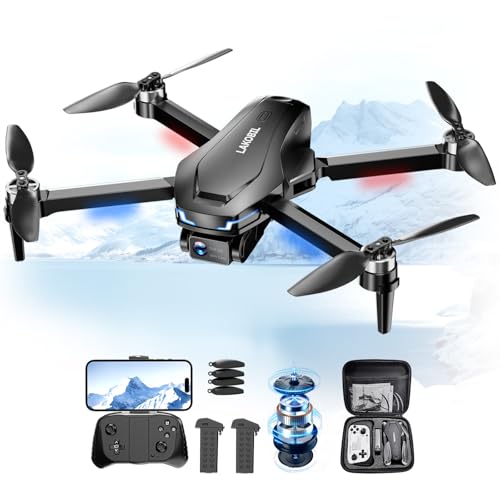
Drone with AI Optical Flow & AI Voice/Gesture Control, 1080P FHD FPV Camera for Kids Beginners Adults, Brushless Motor Foldable RC Drone, One-Key Start, 3D Flips, 2 Batteries 26 Min, Indoor/Outdoor
- AI-Powered Hovering: Smart Optical Flow and Altitude Hold
- Beginner-Friendly Operation: One-Key Takeoff and Headless Mode
- Long-Lasting Brushless Motor: 1503 Motor with 3X Lifespan
As an affiliate, we earn on qualifying purchases.
As an affiliate, we earn on qualifying purchases.
Europe’s AI Regulation vs. Frontier Development
Europe’s AI Act, enacted to regulate the development and deployment of artificial intelligence, is considered a global benchmark. However, a recent independent index shows that European AI models, including those from Mistral, rank at roughly half the frontier level of 56–61, with scores around 30. The trajectory indicates Europe is falling further behind U.S. and Chinese AI labs, which continue to push frontier capabilities forward.
This regulatory focus has prioritized safety, ethics, and compliance, but at the expense of technological leadership. The gap between regulation and innovation raises concerns about Europe’s ability to develop autonomous systems capable of defending against modern hybrid threats, which rely heavily on advanced AI tools.
"The threat we face is not amateurish; it is a professional hybrid scenario, and it represents a new level of danger."
— German Interior Minister Alexander Dobrindt
As an affiliate, we earn on qualifying purchases.
Unclear Aspects of Europe’s AI and Hybrid Threat Response
It remains uncertain whether Europe’s current AI development trajectory can catch up with U.S. and Chinese frontier labs within the necessary timeframe. The specific impact of the recent drone incident on future hybrid threat strategies is also still emerging. Additionally, the effectiveness of upcoming initiatives, such as the Joint Centre for Countering Hybrid Threats, depends on the development of trusted, frontier AI capabilities, which are currently lagging.

Gewbot DIY Robot Model Kit for Raspberry Pi 4/3 Model B+/B WiFi Wireless Smart Robot Car Kit with 4-DOF Robotic Arm/OpenCV Target Tracking/Video Transmission Rasptank Robotic Kit with PDF
- Compatible with Raspberry Pi: Supports RPi 3B/3B+/4 (Pi not included)
- Multifunctional Robot Car: Object tracking, motion detection, line tracking
- Remote Control & Video: Control via PC app, real-time video transmission
As an affiliate, we earn on qualifying purchases.
As an affiliate, we earn on qualifying purchases.
Next Steps for Europe’s AI Sovereignty and Hybrid Defense
European policymakers are expected to prioritize accelerating frontier AI research and development to close the capability gap. The upcoming months will likely see increased funding, new strategic initiatives, and international cooperation efforts aimed at building autonomous defense systems. Monitoring the progress of the Joint Centre for Countering Hybrid Threats and Europe’s AI innovation pipeline will be key to understanding its future resilience against hybrid attacks.

ZOSI 8Channel Surveillance Video Recorders with Human Vehicle Detection,H.265+ Hybrid 1080P 4-in-1 HD-TVI Standalone CCTV DVR System for 720P,1080P Security Cameras,Easy Remote Access(NO Hard Drive)
- Channel Support: Supports 8 wired cameras up to 1080p
- Camera Compatibility: Compatible with HD-TVI, CVI, CVBS, AHD
- Remote Access: Easy remote viewing via ZOSI Smart App
As an affiliate, we earn on qualifying purchases.
As an affiliate, we earn on qualifying purchases.
Key Questions
Why does Europe’s AI regulation matter in hybrid threats?
While regulation ensures safety and ethical standards, it can also slow down innovation. Europe’s lag in frontier AI development may weaken its defenses against fast-moving hybrid threats that rely on advanced AI tools.
Could European AI capabilities have prevented the drone incident?
Not directly. Physical security measures like radar and human vigilance are primary defenses. However, advanced AI systems could improve threat detection and response speed, reducing vulnerabilities.
Why is sovereignty over AI models critical for defense?
Controlling AI models within national borders ensures independence from foreign providers, especially during strained diplomatic relations, and allows tailored, reliable defense systems.
What is Europe doing to catch up in frontier AI?
European authorities are investing in research, establishing dedicated centers, and seeking to develop autonomous, trusted AI systems to enhance national security and strategic autonomy.
Source: ThorstenMeyerAI.com