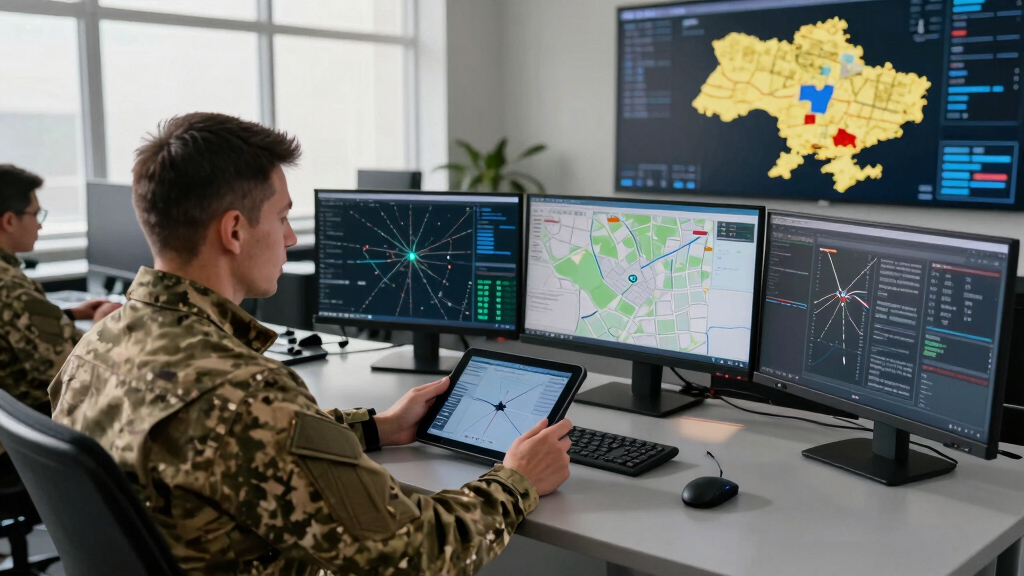

📊 Full opportunity report: Software-Defined Warfare: How Ukraine’s Delta Turned The Battlefield Into A Shared, Real-Time Map on ThorstenMeyerAI.com — validation score, market gap, and execution plan.
TL;DR
Ukraine has deployed Delta, a cloud-native, browser-based battlefield management system, enabling real-time data fusion and command. This exemplifies a shift to software-defined warfare, emphasizing agility and resilience.
Software-defined warfare: how Ukraine’s Delta turned the battlefield into a shared, real-time map
A soldier opens a browser and sees the fused war — drones, satellites, sensors and vetted reports on one live map. The backend is a cloud deliberately hosted abroad so a missile can’t take it down. The clearest case yet of treating warfare as software.
Optical sensors go blind in cloud & dark; an all-weather SAR radar layer — the kind VigilSAR produces — slots into a picture like this as one resilient, sovereign input. vigilsar.com · And note the paradox: to survive missiles & cyberattack, Ukraine hosted its crown-jewel cloud outside its own borders — trading physical sovereignty for operational survivability. Resilience through distribution.
Delta’s lasting lesson isn’t a piece of software — it’s a model of how to build: commodity clients, cloud backend, open standards, relentless iteration, fusion over hardware, and resilience through distribution. It’s why a wartime NGO out-shipped procurement bureaucracies on a fraction of the budget. The platform mattered less than the picture — and the picture is software. Own the fusion layer, own the sovereign feeds into it, and get it to the edge.
Implications of Ukraine’s Cloud-Based Battlefield Management
This development illustrates a strategic shift in military technology, emphasizing software and data over hardware. Ukraine’s use of Delta demonstrates how cloud-native, browser-based systems can expand battlefield awareness, improve coordination, and increase resilience against cyber and physical attacks. The approach challenges traditional defense IT models, which are often hardware-locked and slow to adapt. If successful, it could influence future military modernization efforts worldwide, highlighting the importance of agility, interoperability, and sovereignty in digital warfare. The decision to host critical systems outside Ukraine’s territory also raises questions about sovereignty versus survivability, a debate likely to shape future defense policies.browser-based battlefield management system
As an affiliate, we earn on qualifying purchases.
As an affiliate, we earn on qualifying purchases.
Origins and Evolution of Ukraine’s Software-Defined Warfare Approach
The concept of software-defined warfare traces back to NATO initiatives aimed at breaking down information silos inherited from Soviet-era military structures. Since 2017, Ukraine has been experimenting with more open, interoperable, and rapid software development models, involving NGOs, digital ministries, and defense innovation units. Delta is the latest evolution, embodying these principles by integrating diverse data sources into a unified operational picture. Its development aligns with broader trends in modern ISR (Intelligence, Surveillance, Reconnaissance), emphasizing data fusion and rapid decision cycles. The system’s deployment reflects Ukraine’s broader strategy to leverage technology for asymmetric advantages against a larger adversary, with the added benefit of resilience through cloud hosting outside national borders.“Delta is a game-changer, enabling our troops to see, decide, and act faster than ever before.”
— Mykhailo Fedorov, Ukraine’s Digital Transformation Minister
cloud-native tactical mapping software
As an affiliate, we earn on qualifying purchases.
As an affiliate, we earn on qualifying purchases.
Unconfirmed Aspects of Delta’s Operational Impact
While Ukraine reports high target identification rates and operational success, independent verification of Delta’s battlefield effectiveness remains limited. Details about the system’s full capabilities, integration with drone operations, and real-world resilience are still emerging. The long-term impact of hosting the cloud outside Ukraine’s territory also remains uncertain, especially regarding sovereignty and potential vulnerabilities.
Modeling and Analysis of Real-Time and Embedded Systems with UML and MARTE: Developing Cyber-Physical Systems (The MK/OMG Press)
As an affiliate, we earn on qualifying purchases.
As an affiliate, we earn on qualifying purchases.
Next Steps for Ukraine’s Digital Battlefield Strategy
Ukraine is expected to expand Delta’s deployment across more units and incorporate additional sensor feeds, such as synthetic aperture radar. Further assessments of its operational impact are anticipated as Ukraine continues its counteroffensive. International interest in replicating or adapting similar systems is likely to grow, prompting discussions on interoperability, sovereignty, and the future of software-defined warfare. Monitoring how Delta evolves and its influence on other militaries will be critical in understanding the next phase of digital battlefield innovation.drone and satellite data fusion tools
As an affiliate, we earn on qualifying purchases.
As an affiliate, we earn on qualifying purchases.
Key Questions
What exactly is the Delta system?
Delta is a cloud-native, browser-accessible battlefield management system that fuses real-time intelligence from various sources into a shared operational picture for Ukrainian troops.
Why is hosting Delta’s cloud outside Ukraine significant?
Hosting the cloud externally helps protect the system from missile strikes and cyberattacks, ensuring continuous operation despite threats to Ukraine’s infrastructure.
How does Delta improve Ukraine’s military operations?
By providing a real-time, fused battlefield picture accessible on any device, Delta shortens decision cycles and enhances coordination among dispersed units.
Is Delta’s effectiveness independently verified?
Ukraine reports high target identification rates, but independent verification of Delta’s operational impact is limited, and details remain classified or unconfirmed.
Could this approach be adopted by other militaries?
Yes, the principles of software-defined warfare and cloud-based, interoperable systems are attracting international interest as potential models for future military modernization.
Source: ThorstenMeyerAI.com