📊 Full opportunity report: Phone-based injury-risk movement screening for hiring on IdeaNavigator AI — validation score, market gap, and execution plan.

Get business pricing on monitors, keyboards and dev gear
- Business-only prices and quantity discounts
- Tax-exempt purchasing
- Multiple users, one account, clear invoices
TL;DR
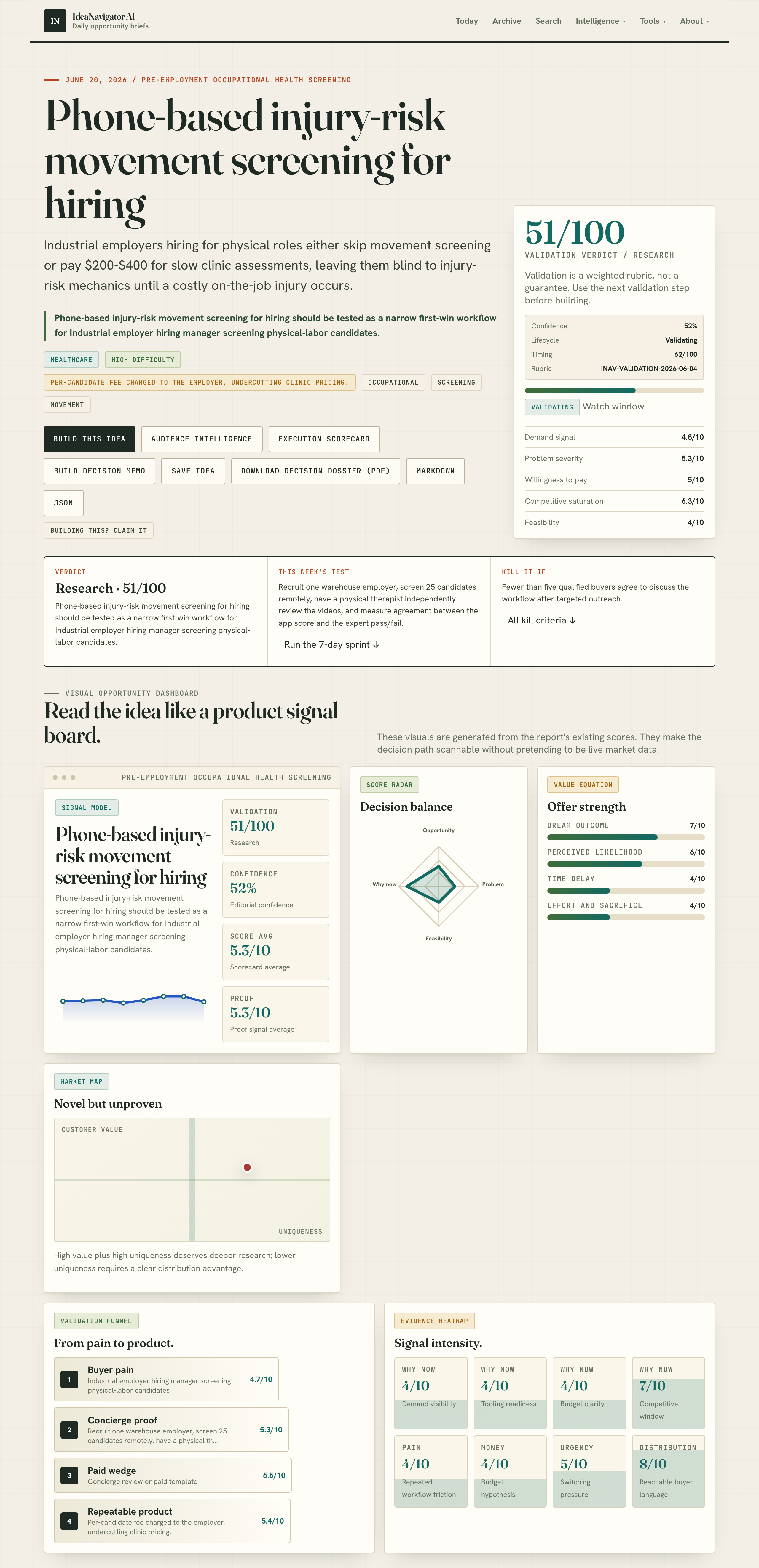
A phone app for remote movement screening is being tested for industrial hiring, aiming to identify injury risks early. It could reduce costs and prevent on-the-job injuries.
A new phone-based movement screening tool is being tested as a potential solution for pre-employment injury risk assessment in industrial hiring. The approach uses smartphone cameras and pose estimation technology to evaluate candidates’ lifting and movement mechanics remotely, offering a faster and more cost-effective alternative to traditional clinic assessments. This development aims to help employers identify injury risks before hiring, potentially reducing costly on-the-job injuries.
The initiative involves a pilot program where a guided phone capture prompts candidates to perform 5-7 specific movements, such as squats, reaching, lifting simulations, and balance holds. The app then provides a pass/fail score based on occupational benchmarks within 24 hours, at a cost estimated between $30 and $50 per candidate. This process is designed to be a streamlined, remote alternative to the standard $200-$400 clinic assessments used currently by many industrial employers.
According to sources familiar with the project, the system will include manual review of edge cases by physical therapists to ensure accuracy. The goal is to validate the app’s scoring by comparing it against independent expert reviews, assessing the agreement between the app and clinician evaluations. The pilot involves screening 25 candidates for a warehouse employer, with plans to expand if results show strong correlation and reliability.
Potential Impact on Industrial Hiring and Injury Prevention
This development could significantly change how industrial employers approach pre-employment screening. By enabling remote, quick, and affordable movement assessments, companies may better identify candidates with injury-risk mechanics before they start work. This could lead to a reduction in workplace injuries, lower workers’ compensation costs, and improved safety standards. Additionally, the approach aligns with broader trends toward digital and remote health assessments, potentially transforming occupational health screening practices across industries.
As an affiliate, we earn on qualifying purchases.
Rising Costs and Limitations of Current Movement Screening Methods
Currently, many industrial employers either skip movement screening due to high costs or rely on slow, clinic-based assessments that cost between $200 and $400 per candidate. These traditional evaluations often delay injury risk detection until after an injury occurs, leading to costly claims and lost productivity. The advent of smartphone cameras and pose estimation algorithms now offers a new pathway for remote, scalable movement analysis. The concept is part of a broader push to incorporate digital health tools into occupational safety protocols, driven by rising workers’ compensation costs and the need for more proactive injury prevention.
“Using phone cameras and pose estimation, remote movement capture is now feasible for pre-employment screening in industrial settings.”
— an anonymous researcher
industrial injury risk assessment tool
As an affiliate, we earn on qualifying purchases.
As an affiliate, we earn on qualifying purchases.
Validation and Reliability of Phone-Based Movement Screening
It is not yet confirmed how accurately the app’s scores will match expert assessments across diverse candidate populations and movement types. The pilot results are still pending, and the effectiveness of manual review processes for edge cases remains to be established. Further validation studies are required before widespread adoption can be recommended.
As an affiliate, we earn on qualifying purchases.
Next Steps in Pilot Testing and Validation Process
The current pilot will screen 25 candidates, with independent physical therapists reviewing the videos to assess scoring accuracy. If results show high agreement, plans include expanding the testing to more employers and refining the app’s algorithms. Additional validation studies and potential regulatory considerations will also shape the tool’s future deployment in occupational screening.
As an affiliate, we earn on qualifying purchases.
Key Questions
How accurate is the phone-based movement screening compared to traditional assessments?
Accuracy is still being evaluated through pilot testing. The goal is to achieve high agreement with expert assessments, but definitive results are pending.
What types of movements does the app evaluate?
The app guides candidates through 5-7 movements, including squats, reaching, lifting simulations, and balance holds.
How much does the screening cost per candidate?
The estimated cost ranges from $30 to $50 per candidate, significantly lower than clinic assessments.
When will this technology be available for widespread use?
Widespread adoption depends on pilot validation results and regulatory approval, which are still in progress.
Are there privacy concerns with remote movement screening?
Privacy considerations are being addressed, including secure data handling and compliance with relevant regulations, but details are still being finalized.
Source: IdeaNavigator AI
Fall Picks
fall essentials
As an affiliate, we earn on qualifying purchases.