TL;DR

Get monitors, keyboards and dev gear delivered free — and shop member deals
- Fast, free delivery on millions of items
- Access to Prime Big Deal Days deals on October 6–7
- Prime Video, Amazon Music and more included
In 2026, eight external GPUs are emerging as key tools for accelerating AI and machine learning workloads. These models offer high performance, compatibility with the latest standards, and future-proof features, making them essential for professionals and enthusiasts. Their adoption signals a shift toward portable, scalable AI infrastructure.
Eight external GPUs are set to launch in 2026, promising to dramatically improve AI and machine learning workloads for professionals and enthusiasts. These models leverage the latest connection standards like Thunderbolt 4 and USB4, offering high data transfer speeds and compatibility, which are critical for demanding AI tasks. The development highlights a growing trend toward portable, high-performance AI acceleration solutions.
The eight external GPUs include models from leading manufacturers such as Razer, ASUS, and others, featuring support for PCIe 4.0 and high wattage power supplies. They are designed to accommodate the latest high-end GPUs like the RTX 4090 and RX 7900 XTX, offering significant performance boosts over internal laptop GPUs. Compatibility with Thunderbolt 4 and USB4 ensures broad device support and fast data transfer, essential for real-time AI processing.
Some models are plug-and-play, aimed at users seeking ease of setup, while others offer upgradeability and advanced cooling for sustained high workloads. Price points vary, with premium options providing enhanced cooling, power delivery, and expandability, catering to different budgets and performance needs. These developments reflect a push toward portable AI hardware that can be easily upgraded or transported.
The 8 picks
- 1
 ASUS ROG XG Mobile (2025) External Graphics Card with NVIDIA GeForce RTX 5090View on Amazon →
 - 2
 MINISFORUM MGA1 External GPU Docking Station with AMD Radeon 7600M XTView on Amazon →
 - 3
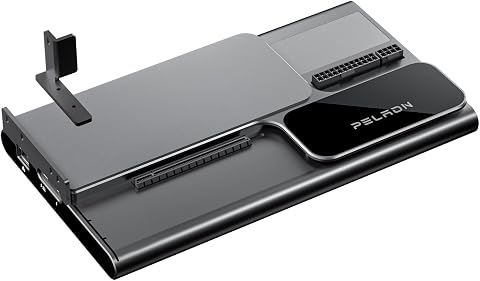 PELADN S-3 eGPU Dock with Thunderbolt 5 Cable – External GPU Dock with PCIe 4…View on Amazon →
 - 4
 Razer Core X V2 External Graphics Enclosure (eGPU)View on Amazon →
 - 5
 MINISFORUM DEG2 USB4 V2 (TBT5 Compatible) & OCuLink eGPU DockView on Amazon →
 - 6
 AOOSTAR AG01 External GPU Docking Station Supports NVIDIA and AMD Graphics Ca…View on Amazon →
 - 7
 MINISFORUM DEG1 eGPU Docking Station for RTX 4090 and AMD RX 7900 XTXView on Amazon →
 - 8
 MINISFORUM DEG1 External GPU Dock Station for RTX 4090 and AMD RX 7900 XTXView on Amazon →
Implications for AI, Gaming, and Creative Professions
The introduction of these eight external GPUs in 2026 marks a pivotal shift in AI and machine learning infrastructure, enabling faster, more portable, and scalable performance. For AI researchers, data scientists, and creative professionals, these models offer a way to significantly accelerate workflows without investing in full desktop setups. Their compatibility with the latest connection standards ensures future-proofing, making them valuable long-term investments. The trend toward portable, high-power AI hardware could democratize access to advanced computing, broadening opportunities for innovation and productivity across industries.2024–2026 Evolution of External GPU Technology for AI
External GPUs have gained popularity as a solution to upgrade laptop graphics performance without internal hardware changes. In recent years, models like Razer Core X V2 and ASUS ROG XG Mobile have set standards for compatibility and performance. The push toward supporting PCIe 4.0, Thunderbolt 4, and USB4 reflects a broader industry move to enable high-speed data transfer for AI and gaming workloads. The upcoming 2026 models build on this foundation, emphasizing AI acceleration, future GPU compatibility, and user-friendly design, driven by increasing demand from AI researchers and content creators.Unconfirmed Details on Specific Models and Performance
While the lineup of eight external GPUs has been announced, detailed specifications, pricing, and exact performance benchmarks remain unconfirmed. It is not yet clear how these models will compare in real-world AI workloads or their compatibility with various laptop brands and configurations. Additionally, the longevity of support and upgrade paths for some models are still under discussion among industry insiders.
Expected Launches and Performance Benchmarks in 2026
Manufacturers are expected to release detailed specifications and availability information throughout 2026. Early testing and benchmarking by third-party reviewers will provide clearer insights into their performance for AI, gaming, and creative tasks. Adoption will likely grow as these models become more affordable and compatible with a broader range of devices, setting new standards for portable AI hardware.
Key Questions
Will these external GPUs support upcoming AI models?
Yes, the models are designed with future GPU support and PCIe 4.0 compatibility, aiming to handle upcoming high-performance AI GPUs.
Are these external GPUs compatible with all laptops?
Compatibility depends on support for Thunderbolt 4 or USB4 ports. Users should verify their device’s connection standards and physical GPU size limits before purchasing.
How much performance gain can I expect for AI tasks?
High-quality external GPUs can approach desktop-level performance, significantly reducing training and inference times for AI workloads, depending on the GPU and connection standard used.
What is the price range for these new external GPUs?
Prices are expected to vary from mid-range to premium, with high-end models offering advanced cooling, power, and upgrade options, potentially ranging from $500 to over $2000.
Will these external GPUs be upgradeable in the future?
Some models are designed with upgradeability in mind, supporting GPU swaps, while others may have fixed configurations. Future support details are still being announced.
Source: ThorstenMeyerAI.com
Evergreen bestsellers Picks
bestsellers
As an affiliate, we earn on qualifying purchases.