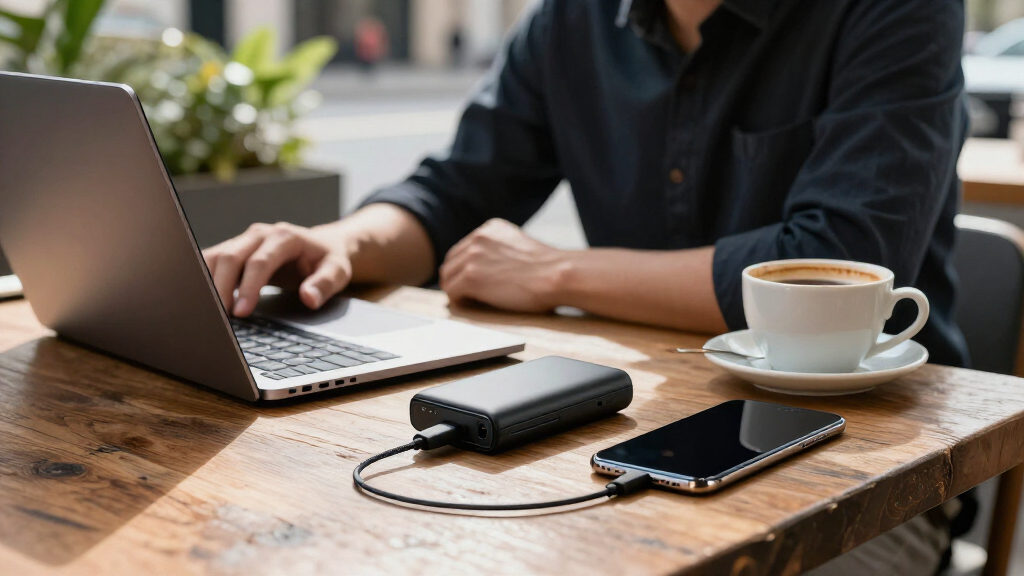
The best power banks balance enough capacity for your day with charging speeds and weight that suit the devices you carry. The Anker Zolo 20,000mAh 30W is my best overall pick for its practical capacity and built-in USB-C cable, while the INIU 10,000mAh 45W stands out for compact carry and faster output. For laptop users, the Anker Prime 26,250mAh 300W offers much more power, with added size and complexity. The main tradeoffs are capacity versus portability, cable convenience versus flexibility, and high output versus everyday simplicity. Read on for the full breakdown and help matching each power bank to your needs.

Get business pricing on monitors, keyboards and dev gear
- Business-only prices and quantity discounts
- Tax-exempt purchasing
- Multiple users, one account, clear invoices
Key Takeaways
- 20,000mAh models are the lineup’s middle ground: they offer more reserve than compact chargers without the extreme capacity and bulk of the 50,000mAh-plus options.
- Built-in cables reduce what you need to pack, but a fixed cable may be less convenient if you use different connectors or need to replace a damaged lead.
- High wattage matters most for laptops and fast-charging devices: the Anker Prime and NOBIS 222W target demanding setups, while lower-output picks fit phones and routine top-ups.
- Very large capacity comes with practical costs: the 50,000–60,000mAh models suit long stretches away from outlets, but their size and airline restrictions can make them poor everyday choices.
- The best pick depends on the devices you carry: compactness favors the INIU 10,000mAh, while multiple built-in cables and LED displays emphasize convenience over pocketability.
| OHOVIV 50,000mAh Portable Charger with 4 Built-in Cables | 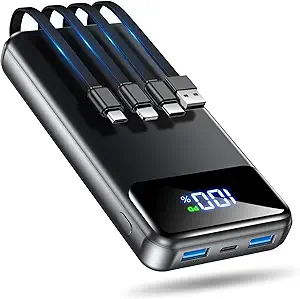 | Best for Cable-Free Group Charging | Capacity: 50,000mAh | Built-in cables: 4: iPhone, USB-C, Micro-USB, USB-A | Charging ports: 3: two USB-A and one USB-C | VIEW LATEST PRICE | See Our Full Breakdown |
| 50,800mAh Portable Power Bank with 25W USB-C Fast Charging, 3 Built-In Cables, and LED Display |  | Best for Maximum Multi-Device Capacity | Capacity: 50,800mAh | Maximum output: 25W | Charging protocols: PD 3.0, QC 3.0, QC 4.0, DCP, FCP, AFC | VIEW LATEST PRICE | See Our Full Breakdown |
| Anker Zolo 20,000mAh 30W Power Bank with Built-In USB-C Cable |  | Best Compact Fast-Charging Pick | Battery capacity: 20,000mAh | Maximum output: 30W | Input power: 20W | VIEW LATEST PRICE | See Our Full Breakdown |
| Orfeika 20,000mAh Power Bank with 4 Built-In Cables |  | Best Lightweight Cable Variety | Battery capacity: 20,000mAh | Built-in cables: 4: iPhone, USB-C, USB-A, Micro | Outputs: 6 total: 3 built-in cables and 3 external ports | VIEW LATEST PRICE | See Our Full Breakdown |
| Anker 20,000mAh Power Bank with Built-In USB-C Cable |  | Best for High-Power USB-C Devices | Capacity: 20,000mAh | Maximum total output: 87W | Maximum single-device output: 65W | VIEW LATEST PRICE | See Our Full Breakdown |
| INIU 20,000mAh Portable Charger with 22.5W Fast Charging |  | Best Compact Power Bank with a Built-In Cable | Capacity: 20,000mAh | Fast charging output: 22.5W | Built-in cable: USB-C | VIEW LATEST PRICE | See Our Full Breakdown |
| NOBIS 65W 20000mAh Portable Charger Power Bank | 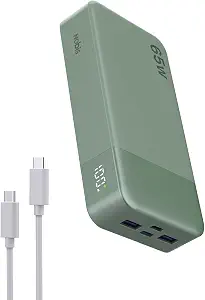 | Best for Charging Several Devices | Capacity: 20,000mAh | Maximum output: 65W | Maximum input: 45W | VIEW LATEST PRICE | See Our Full Breakdown |
| ZZI 60000mAh Portable Charger with 22.5W Fast Charging |  | Best for Extended Off-Grid Backup | Battery capacity: 60,000mAh | Maximum output power: 22.5W | Ports: 3 | VIEW LATEST PRICE | See Our Full Breakdown |
| Anker 25,000mAh Power Bank with 165W Output and Built-In Cables |  | Best for Laptop-Friendly Travel | Capacity: 25,000mAh | Total output: 165W | USB-C ports: 3, up to 100W each | VIEW LATEST PRICE | See Our Full Breakdown |
| NOBIS 222W 25,000mAh Portable Power Bank |  | Best for High-Output Multi-Device Charging | Capacity: 25,000mAh | Maximum total output: 222W | USB-C ports: 2; up to 100W each | VIEW LATEST PRICE | See Our Full Breakdown |
| 50000mAh Portable Charger with Built-in Cables and LED Display |  | Best for Cable-Free Group Charging | Capacity: 50,000mAh | Maximum output: 22.5W | Weight: 0.75 lb | VIEW LATEST PRICE | See Our Full Breakdown |
| Anker Prime Power Bank, 26,250mAh, 300W Fast Charging |  | Best for High-Power Multi-Device Charging | Battery capacity: 26,250mAh | Energy capacity: 99.75Wh | Maximum total output: 300W | VIEW LATEST PRICE | See Our Full Breakdown |
| INIU 10,000mAh 45W Fast-Charging Portable Charger |  | Best Compact Everyday Pick | Battery capacity: 10,000mAh | Maximum output: 45W | Ports: 2 USB-C, 1 USB-A | VIEW LATEST PRICE | See Our Full Breakdown |
| NOBIS 45W 20000mAh Portable Charger Power Bank |  | Best for Sharing Across Everyday Devices | Capacity: 20,000mAh | Maximum output: 45W | Recharge time: 2 hours via USB-C | VIEW LATEST PRICE | See Our Full Breakdown |
| IAPOS 60,000mAh 22.5W Portable Charger with 3-in-1 Cable |  | Best for Extended Off-Grid Use | Capacity: 60,000mAh | Maximum output: 22.5W | Simultaneous charging: Up to 5 devices | VIEW LATEST PRICE | See Our Full Breakdown |
| power bank | Capacity | Maximum output | Dimensions | Weight |
|---|---|---|---|---|
| OHOVIV 50,000mAh Portable Char | 50,000mAh | 22.5W | 5.82 × 2.83 × 1.18 inches | 1.07 lb |
| 50,800mAh Portable Power Bank | 50,800mAh | 25W | 6.02 × 2.75 × 1.69 inches | 1.42 lb |
| Anker Zolo 20,000mAh 30W Power | — | 30W | 4.72 × 2.89 × 1.23 inches | 12.45 oz |
| Orfeika 20,000mAh Power Bank w | — | 20W USB-C PD | 6.33 × 2.85 × 0.74 inches | 0.73 lb |
| Anker 20,000mAh Power Bank wit | 20,000mAh | — | 6.2 × 2.9 × 1.0 inches | 15.5 oz |
| INIU 20,000mAh Portable Charge | 20,000mAh | — | — | Approximately 11 oz |
| NOBIS 65W 20000mAh Portable Ch | 20,000mAh | 65W | — | — |
| ZZI 60000mAh Portable Charger | — | — | 5.8 × 2.9 × 1.1 in | — |
| Anker 25,000mAh Power Bank wit | 25,000mAh | — | — | — |
| NOBIS 222W 25,000mAh Portable | 25,000mAh | — | — | — |
| 50000mAh Portable Charger with | 50,000mAh | 22.5W | 4.4 × 2.8 × 1.2 in | 0.75 lb |
| Anker Prime Power Bank | — | — | — | — |
| INIU 10,000mAh 45W Fast-Chargi | — | 45W | — | — |
| NOBIS 45W 20000mAh Portable Ch | 20,000mAh | 45W | — | — |
| IAPOS 60,000mAh 22.5W Portable | 60,000mAh | 22.5W | 15 × 7.5 × 2.8 cm | 15.5 oz |
More Details on Our Top Picks
OHOVIV 50,000mAh Portable Charger with 4 Built-in Cables
The OHOVIV makes the most sense when several people or devices need power and carrying separate cords would be a nuisance. Its four built-in cable types cover a wider mix of older and newer devices than the Anker Zolo’s single USB-C cable, while three additional ports bring the stated total to six devices at once. The 50,000mAh capacity suits longer outings better than the 20,000mAh options in this roundup. That flexibility comes with a clear tradeoff: at 1.07 lb, it is heavier than the Orfeika and much heavier than a typical pocket charger. Its 22.5W output is useful for compatible phones, but falls short of the Anker 20,000mAh model’s 65W single-device output. Choose it for shared charging and cable convenience; skip it if low carry weight or laptop-level output matters more.
Pros:- 50,000mAh capacity is suited to extended trips and repeated phone top-ups
- Four built-in cable types reduce the number of separate cords to pack
- Three extra ports complement the cables for charging up to six devices
- 22.5W PD and QC4.0 support faster charging for compatible devices
Cons:- At 1.07 lb, it is a substantial load for everyday carry
- The 22.5W maximum output is below the Anker 20,000mAh bank’s 65W single-device capability
- Wall charger is not included
Best for: Traveling families or groups carrying a mix of iPhone, USB-C, Micro-USB, and USB-A devices
Not ideal for: Light-packers and laptop users who want a lighter bank or higher single-device output
- Capacity:50,000mAh
- Built-in cables:4: iPhone, USB-C, Micro-USB, USB-A
- Charging ports:3: two USB-A and one USB-C
- Maximum output:22.5W
- Fast charging:PD and QC4.0
- Dimensions:5.82 × 2.83 × 1.18 inches
- Weight:1.07 lb
- Included:Power bank, user manual, USB-C cable; wall charger not included
Our verdict“Pick the OHOVIV for high-capacity group charging across mixed connectors, provided its weight is acceptable.”
50,800mAh Portable Power Bank with 25W USB-C Fast Charging, 3 Built-In Cables, and LED Display
This model edges the OHOVIV on paper for capacity and output: 50,800mAh and 25W versus 50,000mAh and 22.5W. It also lists six outputs and two inputs, giving users several ways to connect devices, alongside three built-in cables for USB-C, iPhone, and Micro-USB. The LED display makes the remaining charge easier to check than a simple indicator light. Its six-device claim makes it a group-oriented choice, but the 1.42 lb weight is the heaviest among these five picks, and its cable selection omits the OHOVIV’s built-in USB-A cable. The 25W fast-charge capability also depends on a compatible PD charger and USB-C cable. Choose it when capacity and many connections take priority over a lighter bag.
Pros:- 50,800mAh stated capacity supports extended charging away from outlets
- Six outputs and three built-in cables offer flexible multi-device charging
- 25W USB-C PD and QC4.0 support fast charging for compatible devices
- LED display shows remaining power
Cons:- At 1.42 lb, it is heavier than the OHOVIV and the other listed 20,000mAh banks
- 25W fast charging requires a compatible PD charger and USB-C cable
- Built-in cables do not include USB-A
Best for: Travel groups or field teams who need one high-capacity bank with multiple outputs and a visible charge readout
Not ideal for: Commuters and hikers who want to keep pack weight down or need a built-in USB-A cable
- Capacity:50,800mAh
- Maximum output:25W
- Charging protocols:PD 3.0, QC 3.0, QC 4.0, DCP, FCP, AFC
- Built-in cables:USB-C, iPhone, Micro-USB
- Outputs and inputs:6 outputs; 2 inputs
- Simultaneous devices:Up to 6
- Dimensions:6.02 × 2.75 × 1.69 inches
- Weight:1.42 lb
Our verdict“Choose this bank when the extra capacity and connection options matter more than minimizing carry weight.”
Anker Zolo 20,000mAh 30W Power Bank with Built-In USB-C Cable
The Anker Zolo is the more practical fit for solo daily carry than either 50,000mAh bank: it weighs 12.45 oz and has a built-in USB-C cable, while the high-capacity OHOVIV and 50,800mAh model weigh over a pound. Its 30W output also tops their 22.5W and 25W ratings, giving compatible phones and other USB-C devices more headroom. The tradeoff is capacity and connector range: 20,000mAh is less suited to long trips or charging a group, and the single built-in cable type does not match the Orfeika’s four-cable convenience. A 20W input supports faster recharging, though the listed full recharge time is five hours. This is the balanced pick for one person who values a manageable size and faster output over maximum capacity.
Pros:- 30W maximum output exceeds the 22.5W and 25W ratings of the two large-capacity picks
- 20,000mAh capacity balances useful reserve with a 12.45 oz weight
- Built-in USB-C cable is rated for over 10,000 bends
- ActiveShield 2.0 monitors temperature
Cons:- Lower capacity than the OHOVIV and 50,800mAh banks
- Built-in cable serves USB-C devices only
- Full recharge takes five hours
Best for: Daily commuters with USB-C phones who want a lighter bank and faster charging than the 50,000mAh options offer
Not ideal for: Groups, long off-grid trips, or people who need built-in cables for several connector types
- Battery capacity:20,000mAh
- Maximum output:30W
- Input power:20W
- Built-in cable:USB-C, 5.98 inches
- Number of ports:3
- Dimensions:4.72 × 2.89 × 1.23 inches
- Weight:12.45 oz
- Battery type:Lithium polymer
- Warranty:18 months
Our verdict“Pick the Anker Zolo for a lighter everyday bank with 30W output, rather than a shared or extended-trip power source.”
Orfeika 20,000mAh Power Bank with 4 Built-In Cables
The Orfeika is the lightest option here with four built-in cable types, making it a more manageable alternative to the OHOVIV for people who want connector flexibility without carrying 50,000mAh of capacity. Its iPhone, USB-C, USB-A, and Micro cables pair with three external ports, so it can serve a mixed-device group; the stated maximum is six devices at once. At 0.73 lb, it is easier to pack than the OHOVIV or 50,800mAh bank, but still not featherlight beside the 12.45 oz Anker Zolo. Its 20W output is also the lowest among these five, so compatible devices will not get the same charging headroom as the Zolo or Anker’s 65W model. The pouch and battery percentage display add everyday convenience. Choose it for cable variety and lower carry weight, not high-speed single-device charging.
Pros:- Four built-in cables cover iPhone, USB-C, USB-A, and Micro connections
- 0.73 lb weight is lower than the two 50,000mAh models
- Can charge up to six devices using built-in cables and external ports
- LED percentage display and included travel pouch aid packing and charge checks
Cons:- 20W maximum output is below the Anker Zolo’s 30W and Anker’s 65W single-device output
- At 0.73 lb, it is heavier than the Anker Zolo despite having half the stated capacity
- 20,000mAh capacity is less suited to extended group trips than the 50,000mAh options
Best for: Travelers with a mix of phone connectors who want built-in cable variety in a lighter package
Not ideal for: Laptop users or anyone prioritizing the fastest output, since maximum USB-C PD output is 20W
- Battery capacity:20,000mAh
- Built-in cables:4: iPhone, USB-C, USB-A, Micro
- Outputs:6 total: 3 built-in cables and 3 external ports
- Inputs:4 total: 2 built-in cables and 2 external ports
- Maximum output:20W USB-C PD
- Recharge input:Up to 18W
- Dimensions:6.33 × 2.85 × 0.74 inches
- Weight:0.73 lb
- Battery energy:77Wh
Our verdict“Choose the Orfeika for four connector types and a lighter group-friendly design, if 20W output is enough.”
Anker 20,000mAh Power Bank with Built-In USB-C Cable
For a buyer carrying a power-hungry USB-C device, this Anker is the standout: it offers up to 65W to one device and 87W total across as many as three. That gives it a different job from the Anker Zolo, whose maximum output is 30W, and from the cable-rich Orfeika, which tops out at 20W. The 20,000mAh capacity keeps it more travel-friendly than the 50,000mAh group banks, and its built-in USB-C cable avoids packing one extra cord. But at 15.5 oz, it weighs more than the Zolo despite the same stated capacity, and its single built-in cable type is less versatile than the OHOVIV’s four. The supplied data gives no recharge input or display details, so buyers should compare those needs separately. Its listed airline approval makes it a strong travel choice for compatible devices.
Pros:- Up to 65W output to one device suits higher-power USB-C charging needs
- 87W maximum total output supports charging up to three devices
- Built-in USB-C cable is tested for over 10,000 bends
- Listed as approved for airline travel
Cons:- At 15.5 oz, it is heavier than the Anker Zolo at the same stated capacity
- Built-in cable supports USB-C only, unlike the Orfeika’s four cable types
- Three-device limit is lower than the six-device claims of the cable-rich banks
Best for: Travelers charging a USB-C laptop, tablet, or phone that can benefit from up to 65W output
Not ideal for: Buyers who need four built-in connector types, want the lightest 20,000mAh option, or plan to charge more than three devices
- Capacity:20,000mAh
- Maximum total output:87W
- Maximum single-device output:65W
- Ports/devices:Charges up to 3 devices
- Built-in cable:USB-C; tested to withstand over 10,000 bends
- Dimensions:6.2 × 2.9 × 1.0 inches
- Weight:15.5 oz
- Airline travel:Approved
- Warranty:18 months
Our verdict“Choose this Anker for higher-power USB-C charging on trips, if its weight and three-device limit fit your kit.”
INIU 20,000mAh Portable Charger with 22.5W Fast Charging
The INIU pairs 20,000mAh capacity with a built-in USB-C cable, so you can carry substantial backup power without packing a separate lead. Its 22.5W output is suited to fast-charging compatible phones, while the cable doubles as a lanyard for easier handling. Compared with the Anker 25,000mAh Power Bank with 165W Output and Built-In Cables, this INIU is smaller in capacity and far less capable for laptops, but its simpler setup makes more sense for phone-focused travel. A flashlight and thermal sensors add practical touches, and the stated flight-approved capacity suits air trips. The tradeoff is that approximately 11 ounces is still noticeable in a small bag, and Apple users may need an adapter or their own cable. I’d choose it for everyday phone backup, not high-wattage multi-device charging.
Pros:- 20,000mAh capacity in a compact design
- Built-in nylon USB-C cable doubles as a lanyard
- 22.5W fast charging for compatible devices
- Flashlight, thermal sensors, and stated flight-approved capacity
Cons:- Approximately 11 oz adds noticeable carry weight
- Built-in USB-C cable may require an adapter or another cable for Apple devices
Best for: Phone users who want a travel-friendly 20,000mAh bank with a ready-to-use USB-C cable and flashlight
Not ideal for: Apple users without a compatible adapter, or travelers who need laptop-level output or the lightest pocket carry
- Capacity:20,000mAh
- Fast charging output:22.5W
- Built-in cable:USB-C
- Cable material:Nylon
- Weight:Approximately 11 oz
- Additional features:Flashlight and thermal sensors
- Warranty:3 years
Our verdict“Choose the INIU for substantial phone backup with fewer loose accessories, provided its weight and USB-C cable fit your setup.”
NOBIS 65W 20000mAh Portable Charger Power Bank
The NOBIS stands out among the 20,000mAh options for port variety and 65W output. Its two USB-C and two USB-A ports let you connect up to four devices, while PD and QC support fast charging for compatible gear. That makes it a more flexible shared charger than the INIU 20,000mAh Portable Charger with 22.5W Fast Charging, which has a lower output and a built-in cable aimed at simpler phone charging. A digital battery display gives a clearer read on remaining charge, and low-current mode accommodates earbuds and smartwatches. The compromise is that charging speeds depend on device compatibility, and powering several devices at once divides the available output. I’d pick this for a bag shared by phone, tablet, and accessory users; buyers focused on a single phone may prefer a simpler built-in-cable model.
Pros:- Up to 65W output supports compatible higher-power devices
- Four ports: two USB-A and two USB-C
- Digital display shows remaining battery charge
- Low-current mode supports earbuds and smartwatches
Cons:- Actual charging speeds vary with device compatibility
- Output is shared when several devices charge at once
Best for: Travelers or families carrying a mix of USB-C laptops, phones, earbuds, and other devices
Not ideal for: Single-phone users who want a compact, cable-integrated charger and have little need for multiple ports
- Capacity:20,000mAh
- Maximum output:65W
- Maximum input:45W
- Charging protocols:PD and QC
- Ports:4 (2 USB-A and 2 USB-C)
- Display:Digital battery display
- Safety protections:Overcharge, over-discharge, over-voltage, over-current, short-circuit, and temperature control
Our verdict“Pick the NOBIS when one power bank needs to serve several kinds of devices through a mix of ports.”
ZZI 60000mAh Portable Charger with 22.5W Fast Charging
With 60,000mAh capacity, the ZZI is built for extended backup when access to an outlet is limited. Its included 3-in-1 cable covers Type-C, iOS, and Micro USB connections, and the digital display helps track the large reserve. Compared with the IAPOS 60,000mAh 22.5W Portable Charger with 3-in-1 Cable, the supplied details give this ZZI a defined three-port layout and dimensions; its 22.5W output keeps it in phone-and-accessory territory rather than the laptop-charging class of the NOBIS 65W 20000mAh Portable Charger Power Bank. The capacity also brings real travel limits: the product description says it is not allowed on airplanes, and at 1.1 inches thick it is bulkier than a typical everyday bank. I’d reserve it for road trips, campsites, or group use near ground transport.
Pros:- 60,000mAh capacity for extended backup
- Included 3-in-1 cable supports Type-C, iOS, and Micro USB
- Digital display makes remaining charge easier to monitor
- Five-layer safety protections are specified
Cons:- Product description says it is not allowed on airplanes
- 1.1-inch thickness makes it bulky for everyday carry
- 22.5W output is less suited to higher-power devices than the NOBIS 65W model
Best for: Campers and road-trippers who need a large shared reserve for phones and small USB devices away from outlets
Not ideal for: Air travelers or commuters seeking a slim, easily pocketed charger
- Battery capacity:60,000mAh
- Maximum output power:22.5W
- Ports:3
- Connectors:USB Type-A and USB Type-C
- Included cable:3-in-1 Type-C, iOS, and Micro USB
- Dimensions:5.8 × 2.9 × 1.1 in
- Battery charge time:7 hours
- Air travel:Not allowed on airplanes, according to the product description
Our verdict“Choose the ZZI for long trips by road or camp when capacity matters more than airline access and compact size.”
Anker 25,000mAh Power Bank with 165W Output and Built-In Cables
The Anker combines 25,000mAh capacity with 165W total output, giving it more headroom for compatible laptops and several devices than the NOBIS 65W 20000mAh Portable Charger Power Bank. Three USB-C ports can each deliver up to 100W, and the two built-in USB-C cables reduce the need to pack separate leads; the retractable cable extends to 2.3 feet for more flexible placement. Its stated compliance with the 100Wh airline carry-on limit also makes it a strong fit for work trips. That capability has a charging-accessory cost: the charger is not included, and fast recharging requires a 100W-or-higher charger. Compared with the NOBIS 222W 25,000mAh Portable Power Bank, it offers built-in cables and a specified carry-on limit, while the NOBIS adds an extra USB-A port and app control. I’d choose Anker for capable, cable-ready travel charging.
Pros:- 25,000mAh capacity with 165W total output
- Three USB-C ports rated up to 100W each
- Two built-in USB-C cables, including a retractable cable
- Stated compliance with the 100Wh airline carry-on limit
Cons:- Wall charger is not included
- Fast recharging requires a 100W-or-higher charger
Best for: Business travelers who carry a USB-C laptop and phone and want high output with fewer separate cables
Not ideal for: Buyers who lack a 100W-plus wall charger and want fast power-bank recharging without purchasing another accessory
- Capacity:25,000mAh
- Total output:165W
- USB-C ports:3, up to 100W each
- Devices charged simultaneously:Up to 4
- Built-in cables:2 USB-C cables
- Retractable cable length:Up to 2.3 ft
- Short cable length:0.98 ft
- Airline carry-on:Complies with 100Wh restrictions
Our verdict“Choose the Anker for laptop-capable travel charging if you already have, or plan to get, a suitable high-wattage wall charger.”
NOBIS 222W 25,000mAh Portable Power Bank
The NOBIS is the lineup’s high-output choice, pairing 25,000mAh capacity with up to 222W total output across two USB-C ports and one USB-A port. Its listed simultaneous output of 100W + 100W + 22.5W gives a clear path to charging a laptop, another USB-C device, and a smaller accessory together. Compared with the Anker 25,000mAh Power Bank with 165W Output and Built-In Cables, it offers more stated total output and a USB-A port, while Anker supplies two built-in cables and a specified airline carry-on limit. The NOBIS adds a TFT color display and Bluetooth app control for checking battery and port activity. Its drawbacks are practical: device compatibility affects charging speed, and no dimensions or weight are provided, making portability harder to judge. I’d favor it when output and monitoring matter most.
Pros:- Up to 222W total output
- Two USB-C ports support up to 100W each, plus a USB-A port up to 22.5W
- Can charge three devices simultaneously at listed outputs
- TFT display and Bluetooth app provide charging information and controls
Cons:- Charging speeds depend on device compatibility
- Dimensions and weight are not specified
- No built-in cables are listed, unlike the Anker 25,000mAh model
Best for: People who regularly charge a laptop, phone, and USB-A accessory together and want on-screen or app monitoring
Not ideal for: Minimalist travelers who prioritize known dimensions, built-in cables, or a clearly specified airline allowance
- Capacity:25,000mAh
- Maximum total output:222W
- USB-C ports:2; up to 100W each
- USB-A port:1; up to 22.5W
- Simultaneous output:Up to 100W + 100W + 22.5W
- Display:TFT color screen
- Connectivity:Bluetooth app control
- Safety protections:Overcharge, over-discharge, over-voltage, over-current, short-circuit, and over-temperature
Our verdict“Choose the NOBIS when you need high combined output and charging controls for several compatible devices, and can accept unknown carry size.”
50000mAh Portable Charger with Built-in Cables and LED Display
Four built-in cable types make this 50,000mAh bank a practical pick for households or groups carrying a mix of older and newer devices. Its Micro-B, USB-A, USB-C, and Lightning leads reduce the chance of someone being stuck without a cable, while the display shows the remaining charge as a percentage. Compared with the INIU 10,000mAh 45W, it offers far more stored capacity and easier shared charging, but its 22.5W output is less suited to people prioritizing faster charging for a single device. The stated 0.75-pound weight and compact dimensions are appealing for this capacity, though the large battery rating may exceed carry-on limits in some regions. Choose it for long outings with several devices; skip it if airline portability or higher output matters more.
Pros:- Four built-in cable types reduce the need to pack separate leads
- 50,000mAh capacity can support several devices across a long outing
- LED percentage display makes remaining charge easy to check
- Three extra ports add charging options beyond the integrated cables
Cons:- The 50,000mAh capacity may exceed airline carry-on limits in some regions
- 22.5W maximum output is modest beside higher-output options such as the Anker Prime
- Charging five devices at once can divide available output among them
Best for: Families or groups carrying a mix of Lightning, USB-C, USB-A, and Micro-B devices on long outings
Not ideal for: Frequent flyers who need a power bank that fits common carry-on battery limits, or laptop owners seeking high-wattage charging
- Capacity:50,000mAh
- Maximum output:22.5W
- Weight:0.75 lb
- Dimensions:4.4 × 2.8 × 1.2 in
- Built-in cables:Micro-B, USB-A, USB-C, Lightning
- Additional ports:Micro-B input, USB-C input/output, USB-A output
- Display:LED digital percentage
- Safety:Eight-layer protection, including overcurrent, overvoltage, short-circuit, and temperature protection
Our verdict“Pick this for shared, cable-light charging over long days, provided its large capacity suits your travel plans.”
Anker Prime Power Bank, 26,250mAh, 300W Fast Charging
300W total output gives this Anker Prime a distinct role: it can serve power-hungry devices and several connected devices better than the 22.5W high-capacity banks elsewhere in this group. A single port can supply up to 140W, while dual USB-C input supports up to 250W recharging, so the bank can be useful to people who need strong output and a short recharge window. Its 99.75Wh capacity is specified as TSA-approved, unlike the 50,000mAh models whose capacity may exceed airline limits in some regions. The tradeoff is that this level of output depends on compatible devices and cables; 140W needs a 5A cable. Compared with the INIU 10,000mAh 45W, it is a much more capable travel hub but a larger-capacity commitment than a phone-focused everyday bank.
Pros:- Up to 300W combined output supports multiple high-draw devices
- Up to 140W from one port can serve compatible laptops
- Dual USB-C input supports up to 250W recharging
- Digital display, app controls, included 240W cable, and travel pouch add useful control and accessories
Cons:- The full 140W single-port output requires a 5A cable
- Real charging performance varies with devices and conditions
- Charging base is not included
Best for: Travelers with USB-C laptops and multiple devices who need high output and a carry-on-suitable battery capacity
Not ideal for: Phone-only users seeking a small, simple bank, or buyers who need a charging base included
- Battery capacity:26,250mAh
- Energy capacity:99.75Wh
- Maximum total output:300W
- Maximum single-port output:140W
- Maximum dual-port input:250W
- Ports:2 USB-C, 1 USB-A
- Display and controls:Digital display and app-based output controls
- Included accessories:3.3 ft 240W USB-C to USB-C cable and travel pouch
- Battery cell type:Lithium polymer
Our verdict“Choose the Anker Prime if laptop-class output and rapid recharging matter more than a light, phone-first setup.”
INIU 10,000mAh 45W Fast-Charging Portable Charger
Compact capacity with 45W output makes this INIU a better everyday carry for a phone-and-tablet user than the bulky 50,000mAh options in this lineup. Its 10,000mAh rating limits how many recharges it can provide, but the higher output is useful when a compatible device needs a quicker top-up. The three ports—two USB-C and one USB-A—allow more than one device to connect, and the detachable braided USB-C cable can be replaced if it wears out. That cable is only 0.4 feet long, so it is convenient for close-range charging but awkward when a device needs to sit farther away. Compared with the NOBIS 45W 20000mAh, this INIU is the more compact choice, trading half the stated capacity for easier daily carry.
Pros:- Compact 10,000mAh capacity is easier to carry daily than the larger banks in this batch
- Up to 45W output supports faster charging for compatible devices
- Three ports offer USB-C and USB-A flexibility
- Detachable braided USB-C cable can be replaced
Cons:- 10,000mAh capacity may provide limited recharges for larger phones or multiple devices
- The included 0.4 ft cable offers little reach
- Three ports do not make it a high-capacity shared-charging option
Best for: Commuters and light packers who want a compact bank for a phone, earbuds, or a small tablet
Not ideal for: Travelers who need multiple phone recharges or several days of shared charging without access to an outlet
- Battery capacity:10,000mAh
- Maximum output:45W
- Ports:2 USB-C, 1 USB-A
- Included cable:0.4 ft detachable braided USB-C
- Voltage:12V
- Output current:3A
- Additional features:Flashlight and overcharge protection
- Support:3-year INIU Care and lifetime technical support
Our verdict“Choose this INIU for a compact daily backup with useful output, as long as its limited capacity matches your routine.”
NOBIS 45W 20000mAh Portable Charger Power Bank
Four output ports and 20,000mAh capacity make this NOBIS a middle-ground option for people who share a bank among phones, earbuds, and handheld devices. Its 45W output is a step up from the 22.5W IAPOS and 50,000mAh banks, while the two USB-C and two USB-A ports give a group more ways to connect than the compact INIU 10,000mAh 45W. The LCD shows remaining charge, and low-current mode is intended for delicate devices. That extra capacity and port count make it less pocketable than the INIU, and the included package has no charging cable or wall adapter. The low-current mode also takes a double-tap to activate, which may be less straightforward than a dedicated switch. It suits mixed-device charging when a moderate size is acceptable.
Pros:- 20,000mAh capacity balances useful reserve with less bulk than 50,000mAh models
- 45W output supports faster charging for compatible devices
- Four ports accommodate a mix of USB-C and USB-A devices
- LCD display and low-current mode add charge visibility and accessory support
Cons:- Bulkier and heavier than the 10,000mAh INIU compact option
- No charging cable or wall adapter is included
- Low-current mode requires a double-tap
Best for: Small households or travelers who need to charge several phones and accessories from one bank
Not ideal for: Minimalist packers who want a lightweight pocket bank, or buyers who need a cable and wall adapter included
- Capacity:20,000mAh
- Maximum output:45W
- Recharge time:2 hours via USB-C
- Ports:2 USB-C, 2 USB-A
- Display:Digital LCD showing remaining power
- Fast charging protocols:PD and QC
- Low-current mode:Yes
Our verdict“Pick the NOBIS for shared charging across several everyday devices if you can supply your own charging accessories.”
IAPOS 60,000mAh 22.5W Portable Charger with 3-in-1 Cable
60,000mAh capacity makes the IAPOS the longest-haul option in this batch for people who expect to share power across several days. Its integrated cable covers USB-C, iOS, and Micro-USB, and the bank can charge up to five devices using the cable and ports. A digital display helps track the remaining reserve. Compared with the 50000mAh Portable Charger with Built-in Cables and LED Display, it offers a larger stated capacity but fewer integrated connector types; the other model lists four built-in cables and extra ports. The IAPOS weighs 15.5 ounces, a meaningful burden for daily carry, and its 22.5W maximum output is below the 45W NOBIS options. The package includes a 3-in-1 cable, but no recharge time is specified, so planning turnaround is less certain.
Pros:- 60,000mAh capacity provides the largest stated reserve among these five products
- Integrated 3-in-1 cable supports USB-C, iOS, and Micro-USB devices
- Can charge up to five devices simultaneously
- Digital display and listed safety protections help with monitoring and everyday use
Cons:- At 15.5 oz, it is heavy for daily carry
- 22.5W output is lower than the 45W NOBIS and INIU options
- No specific recharge time is provided, and the large capacity may complicate air travel
Best for: Campers, festival groups, and travelers away from outlets who prioritize a large shared reserve
Not ideal for: Air travelers checking battery capacity limits, or commuters who want a light bank with higher-wattage charging
- Capacity:60,000mAh
- Maximum output:22.5W
- Simultaneous charging:Up to 5 devices
- Ports:2 USB-A, 1 USB-C
- Integrated cable connectors:USB-C, iOS, Micro-USB
- Dimensions:15 × 7.5 × 2.8 cm
- Weight:15.5 oz
- Included:Power bank, 3-in-1 USB cable, user manual
- Safety features:Overcharge protection, short-circuit protection, temperature regulation
Our verdict“Choose the IAPOS for a high-capacity group backup on long trips where weight and recharge speed are secondary.”
How We Picked
I compared the 15 listed power banks on usable capacity, output, portability, cable setup, and day-to-day practicality. Capacity can indicate how much reserve a charger offers, but it does not tell the whole story: charging conversion losses, device size, and the number of devices being charged all affect how far that reserve goes. Output matters because a phone and a laptop have different charging needs, while a built-in cable can save packing space but limits cable choice.
The ranking gives priority to balanced usefulness for common buyers, then recognizes products that serve narrower needs well. That puts practical mid-capacity options ahead of very large, heavy banks for general use, while compact chargers and high-output models receive distinct roles. I also weighed tradeoffs visible in the listed specifications; the product names alone do not establish independent test results, exact dimensions, or real-world charging performance.
Factors to Consider When Choosing Best Power Banks
Choose a power bank around your devices and routine, then check the details that determine whether it will be convenient to carry and use. A large capacity or high wattage number can sound appealing while solving the wrong problem.
Match capacity to the time you spend away from outlets
Think about how many times you need to recharge, rather than choosing the largest capacity by default. A compact bank can be enough for a commute or day trip, while longer outings or charging several devices may call for more reserve. The capacity printed on a power bank is not the exact amount delivered to a phone because conversion losses reduce usable energy. Your phone’s battery size and charging habits matter too. If you travel by air, check the carrier’s current rules for power banks and the capacity markings on the device before you fly. Oversizing can mean carrying unnecessary weight on ordinary days.
Check output against your devices’ charging requirements
Wattage determines how quickly a compatible device can draw power, but the charger and device must support compatible charging standards and profiles. A high-output bank does not force every connected device to charge at its maximum rate. For a phone, moderate output may already meet your needs; for a laptop, confirm the laptop’s input requirement and whether the power bank can supply enough through the correct port. When charging more than one device, check whether the listed output is shared across ports. Buyers often focus on the largest wattage printed in a product name and overlook port-level limits. Match the specifications to the devices you actually plan to charge.
Choose cables for convenience and flexibility
Built-in cables can make a bag simpler by keeping a charging lead attached to the power bank. They are especially useful when you often forget separate cables or want to charge quickly during a short stop. The tradeoff is that a fixed cable may not suit every device, and damage can make that built-in connection unusable. Before choosing one, check the connector type and whether the bank still has ports for your other cables. A removable cable gives you more flexibility and is easier to replace, but it adds another item to carry. Pick the setup that fits your devices and how you pack.
Treat portability as part of capacity
A power bank only helps when you are willing and able to bring it along. Larger capacity often means a heavier, bulkier unit, so consider whether it will live in a backpack, work bag, or pocket. For everyday carry, a smaller bank that leaves home with you can be more useful than a high-capacity model that stays behind. For camping or group travel, the extra size may be a sensible exchange for more reserve. Check the manufacturer’s dimensions and weight before buying, since capacity alone does not predict how easy a model is to carry. Also account for the cables and accessories you will pack with it.
Look beyond the headline capacity and wattage
Product names may emphasize capacity, charging speed, or a display, but those figures do not tell you everything about everyday use. Check how many ports are available, which ports support the advertised output, and whether output changes when several devices are connected. An LED display can make remaining charge easier to read, while simple indicator lights may be enough for occasional use. Confirm whether the package includes a wall charger if you need one; a power bank still needs to be recharged between outings. Read the manufacturer’s guidance on charging and storage as well. These checks help avoid paying for features that do not match your routine.
Frequently Asked Questions
How much capacity do I need to keep my phone charged through a day out?
Start with how often you expect to recharge and whether you will also charge other devices. A smaller bank can cover occasional top-ups and is easier to carry; a 20,000mAh-class option gives more reserve for long days or multiple devices. The capacity printed on the bank does not translate directly into the same amount delivered to your phone because of energy conversion losses. If you rarely run your phone low, a very large model may add bulk without much benefit. Choose extra capacity when access to outlets is uncertain or sharing power is part of the plan.
Can a power bank charge a laptop, or do I need a high-wattage model?
Some power banks can charge laptops, but capacity alone does not make a bank laptop-ready. Check your laptop’s required input wattage, the power bank’s output for the port you will use, and compatibility with the laptop’s charging standard. A bank with high total output may divide that output across ports when several devices are attached. Also consider whether its capacity will provide a useful charge while still being practical to carry. If you only need to charge a phone, laptop-level output may add little value.
Are built-in charging cables a good choice for everyday carry?
They can be a good fit if the built-in connector matches your devices and you value having one fewer accessory to pack. A fixed cable is less flexible than a separate lead, and damage can limit the power bank’s usefulness. Check whether the model also has ports for devices that use a different connector. If you share a charger with people using different devices, removable cables may suit you better. The convenience is most useful when the built-in cable covers the charging situations you encounter regularly.
Is a 50,000mAh or 60,000mAh power bank practical for travel?
It may suit trips with long stretches away from outlets, but a very large bank can be heavy and inconvenient for daily carry. Air travel rules for spare batteries depend on the airline and applicable regulations, so check the current requirements before taking one on a flight. Confirm that the capacity is clearly marked on the device and that the bank is allowed in your planned baggage. For ordinary city travel, a smaller capacity may be easier to bring along. Consider how you will carry and recharge the bank as well as how much reserve it offers.
Should I choose faster charging or a larger battery?
Choose faster output if your devices support it and shorter charging stops matter to you. Choose more capacity if you need to recharge repeatedly or share the bank across several devices. The two features solve different problems, and some buyers will benefit more from balanced capacity and output than from maximizing either one. Confirm that the right port supports the advertised speed and that your charging cable and device are compatible. If you usually charge overnight or near an outlet, extra wattage may not change your routine much.
Conclusion
For a balanced everyday choice, I recommend the Anker Zolo 20,000mAh 30W as best overall, combining substantial capacity with a built-in USB-C cable. The INIU 20,000mAh 22.5W is my value-minded pick for buyers who want a straightforward mid-capacity charger, while the Anker Prime 26,250mAh 300W is the premium fit for people charging power-hungry devices. Beginners who want a compact option can start with the INIU 10,000mAh 45W; its smaller capacity is easier to carry and understand as an everyday backup. For extended trips away from outlets, consider a 50,000mAh or 60,000mAh model, but check portability and current airline rules before buying. Match the bank to your devices, routine, and willingness to carry it, and the right choice becomes much clearer.
Fall Picks
fall essentials
As an affiliate, we earn on qualifying purchases.